Author: Massimo Curatella

  • Infrastructural Amorphism: What Bruce Lee Knew About Design

    Infrastructural Amorphism: What Bruce Lee Knew About Design

    Alarm at 07:00 on a Sunday. But I slept a lot. Last night. And the night before. It’s good to be rested. And to enjoy the quiet of early morning, when no one’s around.


    I’m annoyed because I’m not inspired. There’s this faint nausea from lack of clarity. I don’t have a clear idea of what I should be doing and it disorients me. I’d love to dive into the pleasure of writing about something that brings me joy. Yes, exactly — letting myself go into a chain of note connections gives me pleasure. And I want to do it again.

    What blocks me is the vastness of scattered thoughts. Where do I start? Why? What will I have achieved when I’m done? This ruins the anticipation. Either I stop caring and throw myself into enjoying this spontaneous session and whatever happens, happens… or I reflect on objectives, maybe framing them into a path, and ruin the pleasure.

    But the goal of my connective game was never to have a goal. I just had to repeat the exercise a hundred times to gather auto-anthropological data. Nothing more. So I’ve found the answer on my own: I shouldn’t set any goal or hesitation, I just need to carry out the exercise as planned. Trust the system!


    So let’s lay out the protocol:

    1. pick Atom A
    2. pick Atom B
    3. Go wild on whatever connections you find between them and make a damn molecule!

    It’s that simple. Nothing else. Proceed.


    1. Atom A: [[be formless, shapeless, like water]]
    2. Atom B: [[design level]]

    Easy! I have a starting point and I didn’t have to think about it.

    Atom A: “Be water, my friend”

    Let’s read.

    Empty your mind; be formless, shapeless – like water. Now you put water into a cup, it becomes the cup, you put water into a bottle, it becomes the bottle, you put it in a teapot, it becomes the teapot. Now water can flow or it can crash. Be water, my friend. —Bruce Lee

    The first atom comes from an athlete, artist, philosopher. A concept that has always struck me deeply, one I’ve adopted as a way of life, mostly unconsciously. “Be water, my friend.”

    The suggestion — simple and profound — from the great philosopher of martial arts, creative of movement, lethal anatomical machine and self-made man who built a school of thought: well, that suggestion, at least on the surface, is about adapting to your environment.

    “Now water can flow or it can crash.” And those who live where floods sweep away their homes seasonally know something about that — or where houses are uprooted by earth washed away in torrential rains.

    And yet, drop by drop, water appears as the most innocuous and benevolent substance in creation. But put together a few billion billion drops and you get the complexity of a system of drops that becomes an unstoppable force of nature.

    Taking the shape of the container. I don’t know why, but I keep thinking of a concept drilled into me during my early studies: the ideal gas, “which occupies all available space.” It strikes me as an extension of the water concept — water, subject to gravity, can occupy all available space, yes, but pushing downward, where the earth’s force pulls it. Less influential, though present, is gravity’s pull on the ideal gas, which instead expands to fill an aerial volume but, unlike water, goes upward.

    It’s a digression, an extension of the original idea. I don’t even know what to do with it, but I’m noting it down.

    Water taking the shape of its container signals the absence of its own form. Being amorphous, shapeless — it’s not an insult about deformity, it’s not a deviated form, it’s a lack of form. And Bruce Lee invites us to make it a strength. Renounce form — identity? — to take on any form, to assume any identity? Or role?

    As a component of a socio-technical system, then, should we assume the identity of the environment that hosts us? But isn’t this an alienating, estranging concept for a person?

    He’s probably talking about zeroing out the ego, shutting down personal ambitions, the desires that divert us, in order to integrate with the environment. He’s not talking about identity, uniqueness, desires — except by inferring that from water’s formlessness can come both flowing, “the stream,” and destroying, “the crash.”

    He was a fighter, philosopher, teacher of combat. So his philosophy of being formless is, evidently, oriented toward the only objective a fighter can have: winning, by defeating the opponent.

    Flow through the environment, undisturbed and unnoticed, become the container that contains you, and sweep and shatter whatever you meet when you rush like a torrent in full flood.

    After so many years of this passage resonating in my head, after this careful examination, it changes flavor. I tended to interpret the adaptation part — flexibility, ductility — rather than the lethality.

    I’m partly surprised, and not in a pleasant way.

    Atom B: “Design Level”

    Damn, already from the title this promises to be very distant. This annoys me a bit. What if I have to do backflips to connect these atoms?

    Well. Let’s see.

    The passage I extracted on August 29, 2022, is copied dry — no comments, I don’t know why I captured it, nor how I felt about it, no clues on how to connect it or to what. The classic example of an information fragment, without context, feeding the black hole of informational entropy.

    Source: reb00ted | Levels of information architecture. My note is titled [[design level]], and that’s the only personal contribution — the rest is copied and pasted. (Is there perhaps a worse cardinal sin in note management?)

    I’ve been reading up on what is apparently called information architecture: the “structural design of shared information environments.”

    I find this atomic definition very interesting: the structural design of shared information environments. It was there, for many years, and I’m reading it now for the first time. Compact, efficient, effective, beautiful.

    The author proposes a framework to interpret the different levels of scope in which one can interact with a shared information environment:

    So I propose this outermost framework to help us think about how to interact with shared information environments:

    Universe-level: Focuses on where on the planet where a user could conceivably be, and how that changes how they interact with the shared information environment. For example, functionality may be different in different regions, use different languages or examples, or not be available at all.

    Environment-level: Focuses on the space in which the user is currently located (like sitting on their living room couch), or that they can easily reach, such as a bookshelf in the same room. Here we can have a discussion about, say, whether the user will pick up their Apple remote, run the virtual remote app on their iOS device, or walk over to the TV to turn up the volume.

    Device-level: Once the user has decided which device to use (e.g. their mobile phone, their PC, their AR goggles, a button on the wall etc), this level focuses on what they user does on the top level of that device. On a mobile phone or PC, that would be the operating-system level features such as which app to run (not the content of the app, that’s the next level down), or home screen widgets. Here we can discuss how the user interacts with the shared information space given that they also do other things on their device; how to get back and forth; integrations and so forth.

    App-level: The top-level structure inside an app: For example, an app might have 5 major tabs reflecting 5 different sets of features.

    Page-level: The structure of pages within an app. Do they have commonalities (such as all of them have a title at the top, or a toolbox to the right) and how are they structured.

    Mode-level: Some apps have “modes” that change how the user interacts with what it shown on a page. Most notably: drawing apps where the selected tool (like drawing a circle vs erasing) determines different interaction styles.

    I agree, and I like thinking of Information Architecture as “the structure behind the design.” Though we could more correctly say that Information Architecture is the design.

    And this feeds into the age-old discussion about “design” understood as “art,” “creativity” and “colored pixels” and “buttons” versus the famous claim “design is how it works.” In this case we might say: design is how it’s structured. But try explaining that to those who still search for “UX/UI Designer.”

    The author concludes with a laconic:

    I’m just writing this down for my own purposes, because I don’t want to forget it and refer to it when thinking of design problems.

    And I’m left empty-handed when I reread my note and the original article. I realize there’s nothing exceptional here. As a designer, this hierarchy of contexts is entirely natural to me. I understand the author had this realization only then and wanted to jot it down. But why did I capture it four years ago? Wasn’t it this obvious just 48 months ago?

    I’m rather puzzled.

    The molecule: adaptive design means better usability

    With little enthusiasm, the connection between the two atoms pours out spontaneously: it’s obvious that when designing a shared information environment, you need to make sure that the delivery of information — and therefore the interaction with the user — adapts to the user’s needs.

    In other words: accounting for the various narrow and broad levels of context in which the user exists and operates — geographic position, environmental context, devices used, position within the software, navigation and mode of use — the shared information environment must be structurally designed to deliver information in the most effective, efficient (and pleasant) way possible. Which is nothing more than an elaborate (and Proustian) alternative definition of User Experience Design.

    Bruce Lee as an early UX Designer? “Be the environment, my friend”?

    I’m surprised that I’m not particularly surprised.

    What does Bruce Lee know about design that designers have forgotten?

    It’s only after talking to someone else that I finally discover unexpected connections:

    1. The tension between adaptation and lethality as a design principle. Bruce Lee doesn’t just say “adapt.” He says: flow or crash. This duality has a precise equivalent in design: a well-designed information system doesn’t merely adapt passively to user contexts — it reshapes user behavior. Think of forced paths (dark patterns, mandatory onboarding, choice architectures). The water that crashes is design that manipulates. Here lies a molecule with an ethical core, not just a functional one.

    2. Amorphism as renunciation of design identity. I had raised a magnificent question — “isn’t this an alienating, estranging concept?” — and abandoned it. But transposed into design, it becomes: does a system that adapts perfectly to every context still have an identity? Think of the difference between a coherent design system (which maintains recognizability across contexts) and a design chameleon that becomes indistinguishable from its environment. Water has no brand. Can a product afford not to have one?

    3. The ideal gas as an alternative model. My “digression” about gas expanding to fill all available space upward is actually a fertile intuition. Water is bound by gravity (it descends, fills from the bottom); gas expands uniformly. These are two different models of adaptation: one constrained and directional, the other expansive and isotropic. In design, they correspond to two strategies: responsive design (I adapt to device constraints, like water) versus pervasive design (I occupy every available surface, like gas — think notifications, widgets, ambient computing).

    I’m too absorbed in unpacking sources and weak in teasing out connections. I need to do better. How?

    The pattern: I treat unpacking as the “serious” work and connection as a byproduct. But in my exercise the hierarchy is reversed — the atoms are the pretext, the molecule is the product.

    A modification to the protocol

    My three-step protocol is right but lacks an asymmetric time constraint. I should try this variant:

    Phase 1 — Unpacking Atom A (15 minutes maximum). Read, reread, note the visceral reactions. When the timer rings, stop even if you haven’t finished. Write a single sentence: “For me, this atom is about ___.”

    Phase 2 — Unpacking Atom B (15 minutes maximum). Same process, same final sentence.

    Phase 3 — The collision (30 minutes minimum, no ceiling). Here, a precise technique kicks in. Take the two sentences and place them side by side. Then ask yourself in sequence these three questions, each deeper than the last:

    1. What do they have in common? — This is the surface connection, the one that will feel “obvious.” Write it down and then set it aside.
    2. Where do they contradict each other? — Look for the friction point, the tension. In this draft: water renounces form to adapt, but design levels impose structure to function. Fluid adaptation against rigid architecture. This friction is almost always more generative than similarity.
    3. What would a concept look like that contains both without canceling the tension? — This is the real molecule. Not a synthesis that flattens the two atoms into an obvious statement, but a new concept that needs both to exist.

    Why this works

    What I had been doing — unconsciously — was looking for common ground between the two atoms. But common ground produces tautologies (“adaptation is important in design”). The generative connection arises instead from dialectical tension: not where A and B agree, but where they challenge each other.

    In chemistry: a molecule is not the sum of two atoms that resemble each other. It’s the result of a potential difference — one atom has electrons to give, the other needs them. The bond is born from imbalance, not from resemblance.

    An immediate experiment

    So what does this molecule look like?

    • Atom A: “This atom is about renouncing form as power.”
    • Atom B: “This atom is about hierarchy of contexts as necessary structure.”

    I’ve already found the obvious connection (adaptivity). The contradiction is juicier: can a system be simultaneously formless and structured in layers? And if so — what does that system look like? What’s it called?

    There: that thing is the molecule.

    Why this molecule generates further thought

    And now I have a concept — infrastructural amorphism — that I can use as a lens. A system achieves maximum adaptivity not by eliminating structure, but by delegating it entirely to the infrastructure of contexts. The fluidity of content is directly proportional to the rigidity of the architecture that hosts it.

    Bruce Lee wasn’t preaching freedom. He was preaching delegation. Water doesn’t decide its own form because it entrusts that decision to the container. Without the cup, the bottle, the teapot, water is a puddle — not a force, not a flow, not a weapon. Just a shapeless mass subject to gravity.

    Stewart Brand knew this. In his How Buildings Learn, he showed that a building is made of layers that change at different speeds: the site is permanent, the structure lasts decades, the skin resists years, the services renew in months, the furnishings change in days. He called them shearing layers — and the principle is the same: the more stable the infrastructural layer, the more fluid the layers above it can be. Remove the load-bearing structure and you don’t get freedom. You get rubble.

    And so I ask myself: does my Zettelkasten work this way? The notes are the water — amorphous, with no imposed hierarchy — but the system of connections, the tags, the vault’s structure: those are the containers. They are Brand’s deep layers, the ones that change slowly so that everything else can change fast. The more stable and well-designed they are, the freer the notes can be to flow between unforeseen contexts. Like this one.

    And this exercise itself — from two atoms to a molecule — what is it if not a supremely rigid container? Two atoms, one connection, full stop. It’s the load-bearing layer of my thinking: a fixed protocol inside which the content is utterly free to be water.

    I’m surprised to be surprised.


    Creative Molecules, The Project

    1. Italo Calvino, Design, and the Multiverse: Vibrant Unexpected Connections
    2. Infrastructural Amorphism: What Bruce Lee Knew About Design (This article)
  • Italo Calvino, Design, and the Multiverse: Vibrant Unexpected Connections

    My notes are not a storage unit: they’re a graph of possibilities. When I revisit the right nodes, patterns emerge that are useful for thinking and designing.

    After getting tired of accumulating notes without doing anything with them: How I didn’t write this article, I decided to take any two notes and create a third one that describes their connections: Anti-Entropy: from atomic fragments to knowledge molecules.

    The first note: “interconnected ramified lives” — I found it still open from yesterday. Let’s start from here, why not?

    I split my Obsidian screen in half so I can place two notes side by side.

    I remember the satisfaction (what an intense life!) of having found this note again yesterday, so I could connect it with a video I’d found on YouTube. One of the useful techniques for retrieving things is associating them with a concept, a memory, a place.

    Spontaneous connections come to mind:

    • “Memory Palace,” the technique mentioned, for instance, in one of the Sherlock Holmes stories, where the formidable detective manages to remember long, rich sequences of details by mentally placing them inside a memory palace where he can walk through any scene at will, as if it were his personal hard disk.
    • In “Learning How To Learn” the suggestion is to associate concepts or structured ideas with absolutely surreal and comical fantasy scenes — the crazier they are, the more they’ll stick in your memory and be easy to retrieve when needed.

    It turns out this first note is already rich with connections. A suggestion, my dear friend: don’t get lost, stay focused, it’s easy, use this note. It’s already written. And you wrote it. Your past self was generous enough to capture it and save it for you. Respect that time dedicated with so much care. Gather these little seeds of information and place them gently in fertile soil. Why don’t you just comment on these ideas? It’s easy. Come on. Try.

    So… the note is titled “interconnected ramified lives” and — incredible! — I remember the difficulty I had finding a title that was both concise and representative. And I also remember worrying about choosing a title that would be easy to recall the day I’d want to find this idea again.

    I’ve always been fascinated by the complexity that can spring from the combination of simple elements. The moves of a few pieces on a small chessboard. All the possible sequences of crosses and circles in a game of tic-tac-toe. And here, the infinite possibilities of a specific branch of mathematics open up: combinatorics.

    And then, filling a great gap left during my youth, reading the great classics of literature, I found these envelopes of possibility in some great writers like Italo Calvino, Jorge Luis Borges, and Umberto Eco.

    And here, my dear, comes the first note:

    Because in this way all I did was to accumulate past after past behind me, multiplying the pasts, and if one life was too dense and ramified and embroiled for me to bear it always with me, imagine so many lives, each with its own past and the pasts of the other lives that continue to become entangled one with the others. 

    —If on a winter’s night a traveler, Italo Calvino

    Connection! I remember the “click!”, the flash visualised in my brain. And I remember it in three dimensions, animated, interactive, in colour. A tangible world into which I was catapulted instantaneously: a dense tangle of gnarled branches exploding from a root.

    Connection!:

    TREE the very slow explosion of a seed.

    — Bruno Munari “Fenomeni bifronti, Etra/Arte, 1993 Versi” 

    Every branch, a potential path, a possible life. The tree is the set of all possible lives — not just arbitrary or random choices, but truly ALL possible lives.

    Imagine yourself, my friend, reading Calvino’s passage and having this Vivid Vision explode in your mind, where concepts that seemed distant and foreign are summoned like luminescent spirits and transform into parts of a whole that assembles itself into a new concept: connection!

    And this is only the first paragraph. Let’s continue reading.

    I’m producing too many stories at once because what I want is for you to feel, around the story, a saturation of other stories that I could tell and maybe will tell or who knows may already have told on some other occasion, a space full of stories that perhaps is simply my lifetime, where you can move in all directions, as in space, always finding stories that cannot be told until other stories are told first, and so, setting out from any moment or place, you encounter always the same density of material to be told.

    —If on a winter’s night a traveler, Italo Calvino

    Maremma Maiella! Connection! I reread this passage, captured a year ago, and I feel the same electric sensation. I don’t know how useful it is, how important it is, but it’s beautiful! Connection!

    How is it possible that Italo’s words describe what I saw in the private intimacy of my own brain? I’ve never told anyone (until now). It’s an image of mine! Mine alone! And Italo described it decades earlier and turned it into one of the most resonant literary works in history. I was struck then; I’m astounded now.

    Not only is it easy, but it’s so spontaneous that the words gush from my fingertips. And why have I denied myself this intellectual pleasure for all this time?

    But it’s not over. That messy, scrawny note, tossed in perhaps absent-mindedly months ago, has still more to offer. Keep going. Don’t stop.

    «It seems a matter of fact that man — and perhaps woman even more so — needs a certain dose of fiction, which is to say, needs the imaginary as well as the actual and the real. (…) He needs to know the possible as well as the true, conjectures and hypotheses and failures as well as facts, what was left aside and what might have been as well as what was. When we speak of a man’s or a woman’s life, when we trace a recapitulation or a summary, when we tell their story or biography, in a dictionary or an encyclopaedia or a chronicle or chatting among friends, the custom is to recount what that person accomplished and what actually happened. Ultimately, we all share the same tendency, namely, to see ourselves in the various phases of our lives as the result and compendium of what happened to us and what we achieved and what we accomplished, as if this alone constituted our existence. And we almost always forget that people’s lives are not just this: every path is also composed of our losses and our refusals, our omissions and our unfulfilled desires, of what we once set aside or didn’t choose or didn’t obtain, of the numerous possibilities that in most cases never came to fruition — all except one, in the final reckoning — of our hesitations and our dreams, our failed projects and our false or feeble aspirations, the fears that paralysed us, what we abandoned and what abandoned us. In short, we people perhaps consist as much of what we are as of what we have been, as much of what is verifiable and quantifiable and memorable as of what is more uncertain, undecided and blurred; perhaps we are made in equal measure of what was and what might have been.»

    — Tomorrow in the Battle Think on Me, Novel by Javier Marías

    What can I say except, once again, shouting: “connection!” Of course. We’re still talking about potential lives, lived lives, and lives that might have been. This note is formidable — it’s a resonant attractor that with every discovery triggers a small jolt in the pit of my stomach. How could I have captured this gem and let it gather mould in my digital basement? This nearly became a mortal intellectual sin. Never again!

    Not yet satisfied — there are more notes. Let’s go taste them.

    “The Possibility Machine.” At this point, shivers run down my spine and the skin on my forearm stiffens into bristling bumps of trembling pleasure.

    Some pictures are just for me. They’re part of the thought process, answers to questions I have about possible outcomes. I’ll share them with my peers to get their input on a problem I’m working on. Call these pictures that discover. The purpose of a picture that discovers: explore the vast space of possible designs. Visualize alternate realities. Play. Pictures that discover are usually messy, unfinished, abandoned once the exploration is done. They’re sketches in notebooks, moodboards filled with screenshots, and unlabeled artboards in Figma. In some ways, the messiness of these pictures is a symptom of modern design tools’ ways of keeping many copies of your work side by side. It’s a brilliant way of time traveling, creating many branches of reality where you can explore the possibilities of design decision. But the tools don’t often have a way of organizing or managing the copies of your work.

    — Pictures of websites by Matthew Strom

    There are pictures that discover, define, deliver.

    I’m speechless. I’ve connected Calvino’s potential lives in his novel with combinatorics, the visualisation of possibilities, fate and the effect of choices, the intertwining of lives, and now — splendidly — the tree of possibilities that a designer has and can reveal when exploring possible solutions through prototypes. I’m speechless. I admire, moved, in silence.

    Everything I’ve recounted so far happened in my “Second Brain” (a term I ardently despise), somehow without my “first brain” knowing. Since I started systematically using Obsidian and got into the habit of annotating things, I do it (evidently) in such an automatic way — I’d call it, at this point, “in a trance” — that I forget about it immediately after. Is this a good thing? A bad thing?

    If I capture the inspiration and the motivations that drove me and am then able to “relive” that context: it’s a good thing, definitely.

    But if I forget about it forever or can’t find it when I need it, it’s an absolute disaster.

    Here lies the inestimable value of this exercise: giving new worth to the thousands of notes scattered across my various brains, celebrating their happy intuition, and sowing seeds for further development.

    And it’s not over. Let’s go to yesterday.

    [[2026-02-12]] I was able to find this note again searching “connected lives”.

    I like thinking about ramified lives as the graph depicted in this video:

    Are you pondering what I’m pondering? Connection! A three-dimensional, interactive visualisation of all possible combinations of moves in a puzzle. A visualisation that lets you appreciate the extent, the nature, the shape and the complexity of what unfolds from what seems like an innocent pastime.

    Serendipity: The molecule I found is a different one 

    My notes are precious: this makes me feel good. In the apparent chaos of my jottings, treasures lie waiting to be discovered. Deciding to dedicate time to rediscovering old notes and developing them into chains of ideas is a precious activity that gives value to my intuitions and allows them to grow into more elaborate ideas. Revisiting past notes is not necessarily boring or painful: discovering notes in which evidence of intuition accumulates signals the importance of that subject to me and allows me to discover patterns. Unlike unmotivated or mandated research, going to browse through my spontaneous notes can bring genuine joy and delight: this is the world of ideas I love to inhabit.

    There would be dozens of connections to chase — every note calls another. But what strikes me is that an unexpected connection emerges at a meta level:

    • Atom A: The act of note-taking is almost unconscious, “in a trance” — I capture intuitions and then forget them.
    • Atom B: The act of revisiting those notes generates an emotional and cognitive reaction disproportionate to the effort — the chain of “connection!” moments, the shivers, the emotion.
    • Molecule: Writing and rereading are two halves of the same cognitive gesture, separated by time. My “past self” wasn’t simply taking notes — it was sowing seeds in the soil of my future mind. And the molecules exercise is the deliberate act of going to harvest those seeds.

    This is Molecule Zero. It wasn’t planned, it wasn’t expected — it emerged while I was trying to figure out where to begin. And perhaps that’s exactly right: a project about connecting ideas could only be born from an unexpected connection.

    Until the next molecule: two atoms, one bond, a small deliberate act of meaning. Let’s see where it leads.

  • Anti-Entropy: from atomic fragments to knowledge molecules

    My Problem with the Creative Process

    Intellectual dispersion: I read and write without method, accumulating mountains of notes but producing no synthesis.

    My Zettelkasten archive has become a chaotic attractor, which according to systems theory is a system that captures energy (your readings, thoughts, fragments) but fails to crystallize it into emergent structures.

    My creative system lacks an aggregating force that fosters the emergence of organized structures. I have too many atoms and no mechanism to bind them into molecules.

    The force I feel is missing is deliberate synthesis: the intellectual activity dedicated to extracting order and meaning from the chaos of notes.

    Information entropy: The natural tendency of an information system to increase disorder when an external aggregating force is absent.

    For me, writing is an essential activity for organizing my thoughts, feeling better psychologically, keeping track of my life.

    Precisely because my notes are chaotic, my thoughts suffer as well.

    I’d like to think that having pockets of low information entropy in my notes could contribute to the coherence and clarity of my thoughts.

    I’d also like it to be a way to grow culturally and intellectually. But I can’t develop a project beyond the initial enthusiasms.

    How to Move from Intellectual Dispersion to a Generative Force?

    I’m heavily unbalanced on the acquisition and storage aspect of notes, ideas, and jottings.

    I need to introduce greater balance in my creative process so there’s a healthy contribution not only of reflection but especially of synthesis.

    I wouldn’t want to trivialize this delicate phase of thought, but if I had to brutally summarize these aspects, I’d say I need to dedicate less time to capturing information fragments and more time to explaining why they’re interesting and how they connect with others.

    Another major problem I constantly re-examine: all this high-level, abstract analyzing risks being superficial and useless if not grounded in practical applications.

    Although reading and spontaneous selection can be deliberate and free, it’s unwise and naive to think of joyfully wandering the world gathering its fruits in the hope that one day wonderful knowledge gardens will spring up.

    Although in an iterative and incremental manner, I need to develop a vision and a research strategy. What are the topics at the intersection of greatest utility for my purposes? In other words, what is, for me, interesting and useful for living a good life?

    I see nothing but the parallel development of the two canonical approaches I so like to remind myself about: “top-down” and “bottom-up.”

    The intentional, top-down approach: I have a life that dictates certain requirements in terms of what I can and must do. I must therefore carefully consider my non-negotiable responsibilities. To this I add desires (sometimes I can even consider them dreams) which I’ve proven unable to pursue in a spontaneous and disinterested manner. If, therefore, for example, I want to satisfy myself by publishing a book under my name containing something I’m proud of and happy with, I can do nothing but see it as a seriously organized project.

    The spontaneous and serendipitous, bottom-up approach. I’m a master at this: I read, nibble and pick at things, curious, I sample and poke at everything that stimulates curiosity. Fortunately, my note-taking method has greatly improved and I manage to capture 5-10 ideas daily, sometimes from external sources, often from thoughts, inspirations, or intuitions. From this point of view I feel very satisfied, I have a good starting base.

    Mini-Essays Worked in the Past

    Although today I look with tenderness and embarrassment at the vast majority of the 400 articles I’ve published, I must say they played a fundamental role in unlocking my writing fluency and confidence in forming a daily creative habit.

    In a second and third wave of attempts, I remember improving my methodological approach and some essay structures emerged suitable for these brief but intense creative bursts.

    I remember the Panino Technique, a brutally simple way of dividing the written piece into three parts: the outer bread slices, the introduction and conclusion, and the filling contained between them, the development. Far be it from me to claim the innovativeness of this canonical and ancient structure, but by playing with the playful assignment of names and creating simple and easily applicable formats, I had decent success not only in applying it dozens of times but also in persuading other creative companions to adopt it.

    From Sandwich Essays to Atomic Notes

    During my numerous wanderings far and wide with the Zettelkasten method, I found convergence or at least affinity between atomic notes and the Panino Technique.

    Indeed, if I look at some mini-essays I’ve published, I find the pleasant sensation of some notes — brief, well-written, concise — that explain an idea in a clear and immediate way. What better way to create an information unit that can be connected with others?

    So the spontaneous daily practice of writing mini-essays has always been overlapping with that of tending my knowledge garden.

    Too bad the two worlds haven’t yet effectively integrated: my blog lives only online, while my notes live only offline.

    The mother rule of Zettelkasten, if you want to pursue real integrative thinking and have a single place to collect all your written thoughts. It must always be immediately possible to link notes together without any friction or incompatibility. Sure, I can write a link to a blog article but I’ve violated the sacred continuity that Zettelkasten dictates. Creating connections is the elementary activity of this method and everything must live within the archive.


    From Atoms to Molecules

    And here’s my most recent realization:

    • I write a lot but in a dispersive manner
    • I need to connect my notes but I lack the method
    • So I decide to pick two ideas from my archive to generate a third note that illustrates their combination
    • Leveraging my previous experience in writing daily: I decide to do it on my blog because I know I can do it and it worked in the past

    How it will work concretely: Each molecule will be born as a permanent note in my offline Zettelkasten, where I can work freely without pressure. Once completed, I’ll publish it as a blog post. This hybrid workflow allows me to maintain the integrity of my personal archive (all connections live in the Zettelkasten) while leveraging the social pressure of the blog as external motivation to maintain daily discipline. The blog becomes the public showcase of a process that happens in the private forge of my notes.

    A Work Schema for Connecting Information Atoms into Knowledge Molecules

    Atomic idea 1 → connection with Atomic idea 2 → generates Knowledge molecule.

    How to choose the ideas?

    • Reading queue, or fleeting notes
    • Random
    • Current project
    • Curiosity
    • Imminent preparation

    How to connect them?

    • Analogy
    • Metaphor
    • Comparison
    • Contrast
    • Order
    • Set theory
    • Contradiction
    • Support
    • Evidence
    • Argument
    • Counter-argument

    What form does the generated molecule have?

    • New title
    • Description
    • References, atoms
    • Motivations
    • Extension
    • Is it a pattern?

    How is the created note organized?

    • Permanent note
    • Classification
    • Related links

    Atomic Concepts

    In this treatment I could identify some elementary ideas:

    • Intellectual dispersion — a deviated study and research method that produces information fragments increasing information entropy
    • Entropy — the degree of disorder in a system
    • Aggregating force — which synthesizes scattered fragments by grouping them and thus decreasing information entropy
      • The mini-essays of The 30-Day Writing Challenge, CREAZEE Social Writing Challenge 2023, and Atomic Essays
    • Ideation through combination of elementary concepts
    • Writing formats for mini-essays: the Panino Technique
    • Formation of daily creative habits as a method of intellectual development and fluid generation of ideas and content
    • The external motivation pattern: I need external structures to maintain momentum. This initiative creates a daily micro-deadline, a self-imposed constraint that simulates the external pressure that makes me thrive
    • A coherence engine. Aa system that transforms fragments into recognizable patterns through the deliberate act of connection

    Structured Operational Plan

    Phase 1: Daily Construction of Molecules (Days 1-100)

    Daily action:

    1. I open my Zettelkasten archive
    2. I select two notes/fragments
    3. I create a new “permanent note” that explains why the two chosen notes connect

    Possible Structure of the Permanent Note “Knowledge Molecule”


    Molecule [N] – [Date]

    Atom A

    [One-sentence description] Any sources

    Atom B

    [One-sentence description] Any sources

    Bond

    [My comment on HOW and WHY these two ideas connect]

    Type of Connection

    [Classification: analogy, contrast, cause-effect, application, etc.]


    How I’ll Measure Success

    This is a project with verifiable criteria that will allow me to objectively evaluate, on day 100, whether the experiment worked — not a vague experiment or nebulous aspiration.

    Operational success criteria:

    • ✅ Completion: I’ve produced 100 molecules in no more than 120 days (I allow margin for unforeseen events, but the average must remain close to one molecule per day)
    • ✅ Structural consistency: Each molecule respects the established structure (two atoms, explicit bond, classified connection type)

    Qualitative success criteria:

    • ✅ Emergent generativity: At least 20 molecules have spontaneously generated further reflections beyond the initial bond (follow-up notes, unexpected developments, practical applications)
    • ✅ Recognizable patterns: I identify at least 3 thematic clusters — groups of molecules that naturally aggregate around recurring domains or issues

    Metacognitive success criteria:

    • ✅ Process naturalization: The process becomes progressively more fluid and less effortful. In the second half of the journey (molecules 51-100) the average time per molecule has decreased compared to the first half
    • ✅ Discovery of personal patterns: I’ve identified which types of connections come most naturally to me and which cost me more effort

    Intermediate reviews: On day 33 and day 66, I’ll pause to observe without judging:

    • Which types of connections do I use most frequently?
    • Which thematic domains emerge with greater insistence?
    • Is the process becoming easier or harder?
    • Which molecules seem most “fertile” to me and why?

    These reviews are purely observational, I won’t modify the process, I’ll only collect phenomenological data.

    At the end of 100 days, I’ll dedicate an entire week to complete analysis before deciding whether and how to continue.

    The Underlying Bet

    I’m essentially testing this hypothesis: coherence emerges from forced and repeated connection, not from passive contemplation.

    Instead of waiting for patterns to spontaneously reveal themselves from the shapeless mass of notes, I’m creating a synthesis ritual that forces my brain to search for relationships. It’s an artificial sense-making engine — a machine that transforms entropy into structure through the deliberate and daily act of connecting.

    The crucial moment will be the review on day 100. At that point, I’ll have empirical data, concrete proof of what works for me. And I’ll be able to decide, based on evidence, whether to move to the next level: aggregating molecules into even more complex structures.

    Now I can begin. Molecule 1 awaits me.

  • How I didn’t write this article

    I’ve had the idea for this piece at least six times. I know it’s six because I found them all in the same folder, each with a slightly different title and the same amount of developed text: none.

    Here’s how it works. I get an idea — one of those that light up your brain, that make you think now this one is worth it. For a few hours I’m an organized person: I open a document, find some sources, sometimes I even get as far as a work plan. Then something happens. Actually: nothing happens, which is worse. The idea ends up in a folder. The folder gets fatter. I feel productive.

    This is the point where the story should take a heroic turn. You’re expecting me to say I found the method, the routine, the sacred habit of five hundred words every morning. I didn’t. I found something more interesting: I found the exact mechanism by which I fool myself.

    The illusion of the growing folder

    There’s a perverse feedback loop in accumulating material. Every saved note, every archived source, every idea parked in the right folder produces a small hit of satisfaction. It won’t be lost, I tell myself. I put it in the right place. And this is the most elegant lie I tell myself, because it has the exact shape of progress. It looks like work. It smells like work. But it’s stasis with a filing system.

    The result, after months, is a mountain of material loosely aggregated around interests that clearly matter to me — because I keep coming back, because I keep circling around them — but never developed into something someone else could read. A kind of intellectual compost that never becomes soil.

    The plot twist that isn’t

    The truly ironic part — and a little sad, if you think about it — is that this cycle repeats on the same ideas. It’s not that I get bored and move on. I return to the exact same themes, walk through the same phases of enthusiasm, rebuild the same preparatory structures. Like someone who repacks their suitcase every week for a trip that never departs.

    At some point I tried the route of brutal pragmatism: if it’s not on the calendar, it doesn’t exist. I set reminders. I ignored them with a consistency that, if applied to writing, would have made me prolific. I tried tags, project folders, routines. Each additional layer of organization failed exactly like the previous one, just with more style.

    Diagnosis as yet another form of procrastination

    And here we are at the final paradox: I know exactly what the problem is. I know that my goal is not to collect material. Not to organize it. Not even to process it. My goal is to take a thought, give it a shape, and put it in front of someone who can respond. Everything else — the sources, the notes, the folders, the systems — should serve that purpose.

    I know this. I say it. And I don’t do it.

    Because diagnosing a block with surgical precision is itself a sophisticated form of not writing. It’s the final level of the game: when you’ve exhausted every ordinary procrastination strategy, you’re left with self-analysis. Which is stimulating, which is revealing, and which produces exactly the same result as every other strategy: another note in the folder.

    What you’re reading

    So I did the one thing I hadn’t tried yet. I stopped preparing the jump and just jumped. What you’re reading is not the result of weeks of elaboration. It’s not the outcome of a work plan dutifully followed. It’s a thought that took shape today, and that I decided to publish before the folder swallowed it.

    It’s not polished. It’s not complete. It doesn’t cover everything I wanted to say. And that’s exactly why it exists.

    I’m left with one question, and I’m passing it to you because I genuinely want to know: where do you get stuck? Not the generic, textbook kind of stuck. Yours. The specific one, the one you know well, the one with a precise shape you could describe with your eyes closed. The one you’re probably putting off right now.

    Tell me about it. At least one of us will have taken a step forward.

  • Tools You Don’t Wield

    Tools You Don’t Wield

    Thinking, and tools for thinking

    Why am I so fascinated by this?

    If I were to “satisfy” this attraction, how would I do it? I mean, if it’s an obsession, a continuous desire, why do I have it and keep having it?

    “Tools” is the first part of the attraction. I think of something that empowers, that lets me do what I cannot do without it. I’ve always been drawn to the armor, the sword: facing a “jungle of problems” with equipment that amplifies me.

    But I’d be confusing the fact that “tools for thinking” aren’t necessarily physical trappings, crutches to strap on, or drills to grip, but rather methods, ways, attitudes that concern my thought, my mind.

    Of course, tangible tools exist: books, pen and paper, whiteboards, audiobooks, podcasts, people who talk to you and guide you, but also playing cards, tokens, board games, sticky notes, hourglasses, timers, highlighters, colors, brushes, and so on.

    In theory, if blended with a process that aids thought, anything can be a mental tool.

    A dinner with friends, for example, is for me a powerful tool for thinking. It’s only when I’m in the company of others, around a table, that I manage to have the most memorable conversations, to explore the most abstruse and fascinating topics. Of course, the people make the difference, as does the place, the spread, and above all, the food.

    But then if everything can be a tool for thinking, by definition, nothing is. Or rather, how could I identify specific ones to suggest to someone else who might want to use them?

    Probably it’s the method and the use one makes of them, toward certain ends, that makes the difference. I imagine a tool for thought as: “something, someone, or a way of thinking” that helps me approach a topic or problem differently, hopefully more effectively, that brings me, if not solutions, at least alternative and stimulating ways of looking at my goals.

    I must confess: dinner with fun and stimulating friends is my favorite tool for thinking.

    When shall we meet?

  • Generating Infinite Worlds

    Generating Infinite Worlds

    When we design, we should introduce more emergent complexity.

    In a world that changes even as we try to understand it, we can equip ourselves with methods and tools powered by the same principles as nature: the interaction of infinite elementary components that generate an abundance of opportunities.

    Curation—the ability to observe, filter, and combine an enormous quantity of possible solutions—opens the door to generative creativity, to unexpected solutions, to astonishing surprise.

    But it’s only by abandoning fine control and equipping ourselves with generous reserves of patience that we can guide an experimental exploratory process to reveal new, useful solutions that are unimaginable through more linear and traditional paths.

    A generative, algorithmic vision of creativity can be an important tool for confronting the complexity of modern times.

    I used to do these explorations (once upon a time): instead of drawing by hand, I would write the code that drew for me. It was a beautiful period that I never stop thinking about daily.

    The attached video, fascinating, explains in a non-technical, visual and animated way what emergent complexity is and how we can harness it.

    🍀

  • Find the System

    Find the System

    Systemic reflections on knowledge, representation, and chaos.

    I sense complexity in things that appear simple and in those that clearly aren’t. The ability to understand complexity is important for navigating life, especially in our era of technological acceleration. Acquiring basic skills to recognize complex systems, introduce experiments, and understand how they function can allow us to dance with complexity rather than being overwhelmed by it.

    Greedy Ambitions and Complex Intuitions

    I want to have everything. And if I can’t have it, then I want to know everything. And if I can’t know it, then I want to know how to know it.

    Imagine the human brain: billions of tiny cells in constant dialogue with each other, creating the magic of thought and consciousness. Or think about the Internet, a giant invisible web connecting us all, continuously generating new ideas and behaviors. Knowledge can be a substitute for possession. Just as an artist possesses their subject through carefully placed spots of pigment, deeply understanding a concept is a form of ownership. In English, they say: “To master a concept, a discipline, a topic.”

    In my naive and deluded amateur intellectual dream, I can’t help having intuitions about the reality I know and, especially, about what I don’t know. I sense the complexity of the world, nature, and knowledge itself. Whatever direction I take, I find myself overwhelmed not by what I see, but by what I perceive behind it. My great frustration comes from this mute perception: I intuit but cannot clearly explain the complexity that fascinates me.

    Ubiquitous Interconnections

    Explaining complexity without mentioning the word itself. To question its nature. “Don’t think about systems but about forests. Don’t dwell on hierarchies, think about family relationships.”

    A coral reef isn’t just a collection of breathtaking colors and intricate shapes, but a delicate balance of life in continuous evolution. Cities, with their pulsating crowds and busy streets, tell hidden stories of casual encounters that change lives and entire communities. There’s a hidden thread connecting a regenerating forest, a crowd changing mood, a market crashing, a friendship forming or breaking. It’s not magic, nor simple logic, but something profound and often invisible.

    Those who perceive its traces can no longer ignore them. A trivial event can reveal unexpected connections; a coincidence can show a hidden order. Every decision reveals networks larger than imagined.

    What happens when we recognize what was invisible? How do our thinking and choices change? If everything is connected, every decision matters more than we imagine. Are we ready to become aware of this?

    Represent to Understand

    Drawing and modeling as a substitute for possession: if I can create it, then it belongs to me.

    Imagine Earth’s climate, a gigantic puzzle where each piece influences the others, making every prediction a fascinating challenge. Or think about the global economy, where a single transaction can create waves that cross continents.

    Sometimes I fall in love with my own ideas and feel adolescent enthusiasm when diving into the most disparate projects. It’s only when I clash with execution, problems and their infinite solutions, it’s only when I get my hands dirty with research, experimentation, and testing that the flavor of my intuitions changes. What were exciting visions of new technological and intellectual territories to conquer often become hard and intense work sessions where I rack my brain while making slow and uncertain progress.

    Yet mapping the visible pieces and the connections between them to explain how they work often becomes a liberating first approach. Visualizing a context, a problem, a system is a powerful investigative activity that allows you to define and understand the context of the problem you’re facing. Visually representing a system or problem is often the first step to truly understanding it.

    Prototyping becomes a fundamental tool: a prototype is a quick and economical draft to explore possible solutions before their final implementation. Often a drawing, a map, or a network of concepts is enough to clarify ideas and choose the best path.

    How do you represent love?

    “There’s no love in a carbon atom,
    No hurricane in a water molecule,
    No financial collapse in a dollar bill.”
    – Peter Dodds

    Not everything can be drawn. Not all phenomena can be represented.

    How do you capture the emotional complexity of a relationship through words or drawings? Imagine a network of friendships and loves, emotions intertwining in ever-new ways. Or think about art, which escapes precise definitions, creating sensations that transcend words themselves. How do you draw a tornado? A beach of fine sand? How do you represent pain, or the relationship between a father and child?

    The complexity of some phenomena lies in the very difficulty of representing them. When mapping and inventorying aren’t enough, other approaches are used: narrating the nature of the phenomenon, describing its components and behaviors.

    But how many can feel the beauty of a musical piece by reading the score? How many different descriptions would we get if we asked ten people to describe Albinoni’s Adagio?

    A Beautiful Problem

    Thermodynamic death of the Universe, I don’t fear you.

    Imagine a global pandemic, a small virus that brings the entire world to its knees, showing the incredible interconnection of our existence. Or think about political systems, intricate games of power and influence that often escape our immediate understanding.

    Defining complexity is already a complex problem. I’m fascinated by the difficulty in finding simple definitions. We talk about complexity sciences because it doesn’t belong to a single discipline but requires the union of many scientific approaches.

    Yet, if you ask seventy-five scientists for the definition of complexity, you’ll get seventy-five different versions.

    “Sapere Aude“

    In an increasingly complex, accelerated and accelerating world, where everything is interdependent, tangled, interconnected, why subject yourself to the torture of studying the most difficult things in the world?

    • Because you can, as the guy who wanted to climb Everest said.
    • Because the entropy of the universe increases, complexity can only increase.
    • Because understanding how things work is both a totalizing and satisfying purpose and a means to live better and help others live better.
    • Because we must explore the universe to its limits, if it has any, and return home with different eyes, or find new complexities to explore.
    • Because we must dare to know.

    Find the System: An Exploratory Approach

    “I think the next [21st] century will be the century of complexity.”
    – Stephen Hawking

    We need, then, both a methodology and a mindset—an approach to complexity through systematic observation, representation, and interconnection. We must perceive the hidden systems operating beneath the surface of everyday reality: from social dynamics to natural phenomena, from information flows to emotional landscapes.

    We can search for the system based on three fundamental principles:

    1. Recognition: Perceiving systemic patterns in apparently chaotic or isolated phenomena.
    2. Representation: Developing tools and languages to capture systems that resist traditional modeling.
    3. Recursive Understanding: Recognizing that the observer is part of the observed system, creating a continuous and reciprocal feedback loop: our investigation influences systems, and systems influence our understanding.

    We can then imagine exploratory exercises, visualization techniques, and conceptual frameworks to confront complexity without oversimplifying. We’ll embrace the paradox of understanding complex systems that requires both analytical precision and holistic intuition—the ability to zoom in and out of different scales of organization.

    It’s not about conquering complexity, but learning to dance with it—learning to appreciate the beauty of interconnected systems while developing practical tools to navigate with greater awareness and effectiveness.

    Find the system.

  • Convergence of Ideas

    Convergence of Ideas

    A Personal Journey Toward Intentional Creation

    “The future cannot be predicted, but futures can be invented.”
    — Inventing the Future, Dennis Gabor, 1963

    In recent years, I have embraced a habit that has radically transformed how I think and learn: every day, I reflect, write, and capture ideas that inspire me. But it wasn’t always this way.

    Once, my mind was a vortex of stimuli: articles, videos, conversations—a continuous stream of information dissolving into chaos. Imagine trying to hold sand in a sieve too large. Every grain slipped away, leaving me with a sense of incompleteness and fragmentation.

    The real transformation began when I decided to create a digital space to bring coherence to my ideas. This space is not just an archive but an intellectual haven where every thought finds a place, ready to be reworked and connected to others. It has been a gradual process—built through trial, error, and continuous improvement—but each step has brought me closer to a system that makes my learning meaningful.

    Now, I find myself at a new crossroads. I no longer want to simply gather and organize; I want to create. In the past, I wrote spontaneously for my blog and newsletter, rarely drawing on my notes and focusing on the immediacy of writing. At most, I refined a draft, without worrying about connecting ideas or weaving them with previous articles. The change I want to introduce now in my creative process is to capitalize on an active archive of interconnected thoughts. I want to transform what I’ve accumulated into something tangible, useful, and meaningful. This requires time, dedication, and above all, persistence—a reminder that true creativity is not a fleeting spark but a deliberate act.

    I cannot predict the future, but I can invent possible ones. Every step forward, every connection between ideas, is an act of building.

    On this journey toward intentional creation, I recognize patience as my greatest ally. Each day is an opportunity to add another piece, to shape the mosaic I am building. I am ready to face this challenge, one idea at a time.

    I share these thoughts, admittedly, for myself. It’s a way of tracking my progress and ambitions with an increased accountability. It gives me an extra motivation to keep working on them. It frightens me to conclude with a declaration of commitment, a provocative question that pushes me toward the direction I am envisioning. Yet, perhaps that’s the right reason to be courageous and launch it—aimed at myself, to be answered tomorrow.

    What future am I inventing?

  • Creative Growth Reflections

    Creative Growth Reflections

    I had a lot of fun when I wrote spontaneously, without too many expectations. The painful beginnings were just that—painful. It’s a bit like learning to ride a bike or learning a new language: I have legs, and I know how to use them to walk, but pushing on the pedals and trying not to fall is challenging, frustrating, and sometimes, you even smash your face. Then, slowly, I got going, smoothly. And do you know why I was doing well? Because I didn’t care about what I was writing. The important thing was to make use of those minutes stolen from life, often at night to have a creative moment all to myself. The second hurdle was publishing it online. Fears, doubts. What if I write nonsense? What if I offend someone? What if I make a fool of myself? I think I had the chance to answer all these questions and more simply by continuing to publish. Once I got going, I began to reflect on what I wrote. What had I written? Would I ever be interested in reading it again in the future? When I acquired the good habit of writing every day, I began to wish for a direction, a common thread. This brought up the first doubts. The daily cadence, if not prepared with significant efforts, is peremptory and inexorable. There’s no room for iteration or incubation. You have to write in half an hour and publish, which takes another half hour.

    After about 400 articles, I completely grounded to a halt. It had become a burden, a weight. Having to organize the day with the constant thought of writing something was unbearable. And the more I suffered from the pressure, the less satisfied I was with what I wrote. Until, without warning, and unfortunately with relief, I simply stopped. Every so often, I felt the itch in my meninges and fingertips. I have a billion thoughts in constant flow and at least three or four (hundred) times a day it seems I have that idea, that insight, that connection that deserves to be captured. But life flows on. The scroll refreshes the feed, and it all vanishes in a few minutes like a fantastic dream in which you can no longer outline the blurred contours.

    Change of medium: I tried podcasting. Ambitious, eager to plan, to embrace, once again, all human knowledge, I forced a group of poor friends to go on video with me. It was a nice experiment, I learned a lot. I had only one goal, to make 10 episodes. I did them. Good boy. And now?

    Too much work, too demanding. Let’s see what happens after a short break. The break still lasts. Let’s go back to the newsletter then. The first of the year, a magical day: I will write a new edition of my newsletter every week. I will experiment with AI, in ideation, revision, and illustration. Great initial fun. Not much conviction. But I kept up the pace. The goal was to make at least 10 editions before screaming to the world. Indeed, I didn’t promote it at all, maybe just a link on X. And then, on yet another Saturday night with the newsletter deadline the next day, I put something together quickly and sloppily, annoyed, and unsatisfied. It never came out. It made no sense. I wasn’t convinced.

    And this brings us to today. I recognize defeat. This is not the way I love to cultivate my creativity, it does not belong to me, and I do not recognize myself in it. Ironically, one of these newsletters was spontaneously linked on social media. Think about it, the first share after five years of publishing online. What a mocking fate.

    So what now? Two weeks of daily reflection led me to completely reconsider my way of writing, but most importantly, that of publishing. I interrupted the weekly publication cadence. So be it. It’s okay. It was useful, once again, to stop and reflect.

    Out of respect for those who read me, although a bit late, I thought to share these spontaneous thoughts. And this makes me feel better. I promise to update you as soon as I have clearer ideas.

    In the meantime, just reply to this message to contact me.

    Thank you for your time.

    Max

  • From Toys to Systems

    From Toys to Systems

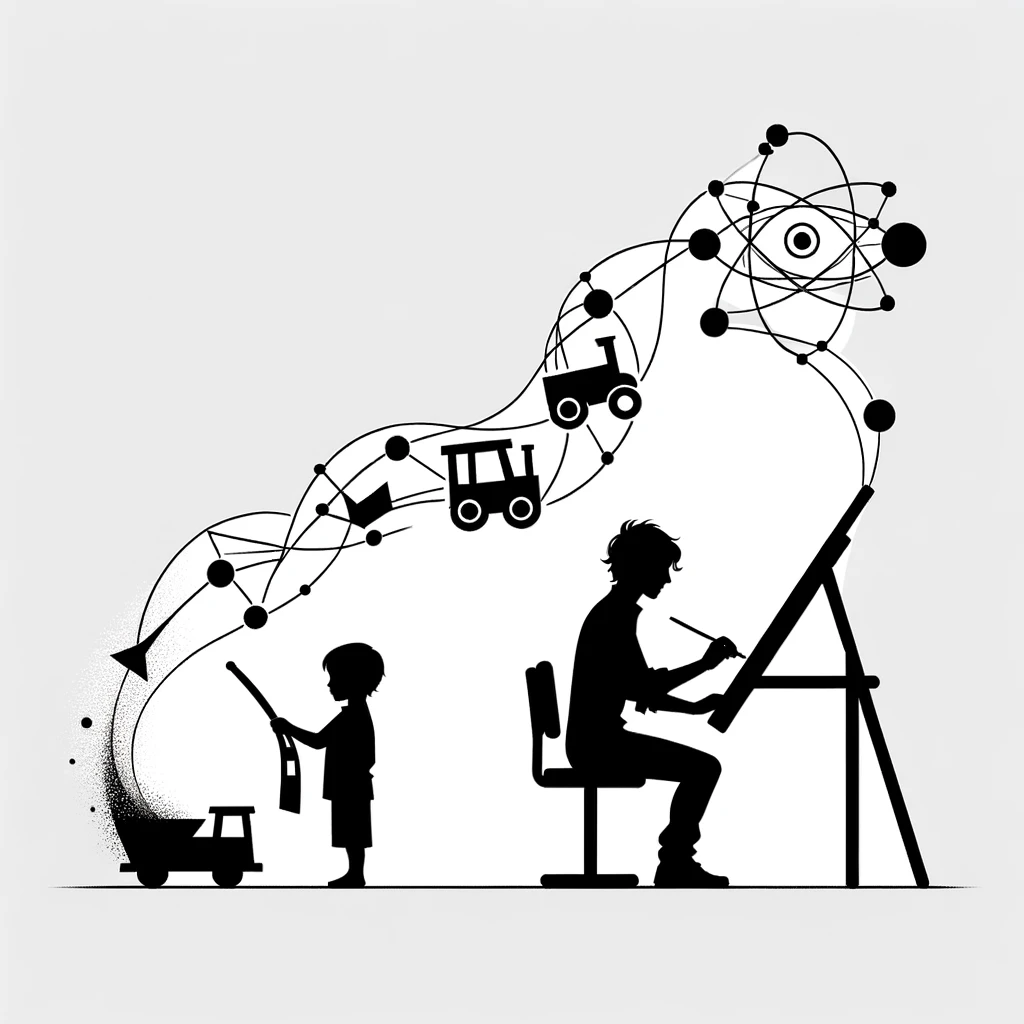
    From a young age, my fascination with how things worked led me to dismantle every toy that fell into my hands, such as the precious fire truck from my grandmother, much to my father’s dismay. This curiosity laid the foundation for who I have become: a computer science enthusiast and, later, a design expert.

    My journey began to take shape when I realized the software I was developing wasn’t meeting user satisfaction. This realization underscored the importance of understanding not just the technical, but also the human aspects of system design. Recognizing that everything is interconnected, I began to see the value of Systems Thinking and Design Thinking as essential frameworks for addressing complex problems.

    Systems Thinking offers a lens to view problems and solutions as parts of a larger whole, emphasizing interdependencies within systems. It taught me that usability issues in software were not merely technical but deeply rooted in a failure to consider the user’s experience and needs comprehensively.

    Similarly, Design Thinking introduced a process-oriented approach focused on empathy, creativity, and user-centered design, highlighting the importance of iterative testing and problem-solving to create solutions that are technically sound, meaningful, and accessible.

    The transition to adopting Systems Thinking and Design Thinking marked a significant shift. It wasn’t just about embracing new methodologies but fundamentally changing how I viewed design and development, ensuring a balance between the abstract beauty of high-level designs and the practical, detailed work required to make them effective.

    This new perspective led me to systemic design, which involves mapping environments and concepts to identify components, interactions, and opportunities, enabling me to tackle complex projects with a critical and innovative eye, always prioritizing the user’s needs.

    Despite the challenges in communicating these complex concepts, I strive to convey the importance of a thorough approach in designing complex tools. I aim to share this vision in a clear, accessible manner, emphasizing the effectiveness of a balanced, articulated thinking process in developing solutions that efficiently meet user needs. This journey underscores the evolution of my professional and personal growth, from curiosity about the workings of toys to a holistic view of design and development that appreciates both the abstraction’s beauty and the necessity of fine-tuning details.