Tag: writing

  • Perfectionism Killed my Creativity

    Perfectionism Killed my Creativity

    I did too much. And I did nothing. This is the story of how being a perfectionist got me stuck. (Photo by John T on Unsplash)

    Failure is an opportunity for learning—about inaccurate pictures of current reality, about strategies that didn’t work as expected, about the clarity of the vision.

    The Fifth Discipline, Peter M. Senge

    Writing every day is my most powerful creative tool.

    Every day? You could ask.

    How come you are writing every day and you publish on your blog every week? You could add.

    And how come your latest article was in April? We’re almost in June. You could infer.

    Yeah, I have excuses. So many I could fill you with them.

    I wouldn’t even need all of my excuses, I could just mention the pandemic.

    You know, that insignificant event taking over the world, recently?

    But the truth is another.

    Perfectionism.

    This killed my publishing schedule.

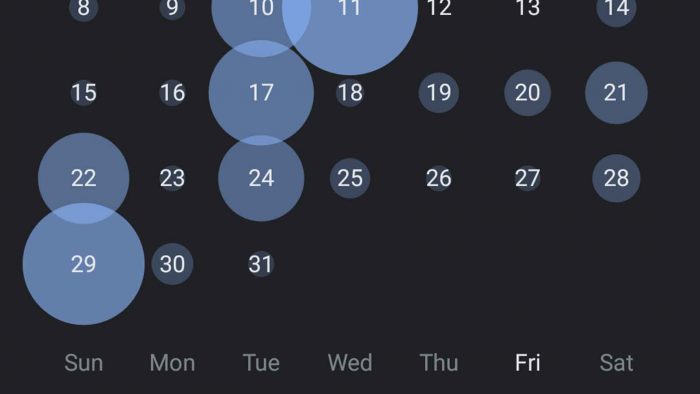
    While, when I write in my personal diary, I flow like oil. I can write from 1’000 to 5’000 words per hour. I’ve reached 250 days of continuous writing for 350’000 words. I can go on and on. I frequently reflect on my work (no, not necessary on why I am not blogging). I think aloud to better form some thoughts. It’s working in understanding better. Who? Me.

    And, frequently, I talk (to myself) about those complex and abstract concepts that float in my mind. Day and night.

    Which ones? I can hear you say.

    Come on, the usual ones: UX Design, Design Thinking, UI Design, Design Systems, management, leadership, Organization Design, parenting, sustainability, Systems Thinking, complexity, emergence, feedback loops, causal diagrams, unintended consequences, Donella Meadows, Peter Senge, Systems Change, social innovation, facilitation, teaching, training, learning, consciousness, the mind, space, writing, thinking, publishing, building an audience, writing the next article, and some other 357 things.

    Writing the next article. Yes. Let’s talk about this for a moment.

    I’ve been “writing the next article” for more than a month, now.

    It’s the next episode of the “OsservAgro” saga. It was one of the most stimulating experiences I had in 2019. I have a mountain of notes and ideas about it. And I committed to myself to tell its story. My experience. How I did it. What I’ve learned. What we did together. What we could do.

    But I wanted to be a historian. I wanted to tell exactly what happened, who said what, what I replied, what I thought, what I did, and what we achieved at the end.

    That is not an excellent way to summarize an experience. I am afraid.
    The more I recalled about the first workshop I facilitated, the more I wrote.
    The more I wrote, the more details I recalled.
    The more I wrote the more ideas, facilitation methods, tricks, reflections came to my mind.
    And the more I wrote.
    So, after a month, what was a 1’000 thousand-words essay is now 5’000.

    And I feel exhausted. And nausea comes to me if I reopen the third draft. I don’t want to publish it. It’s too long. It’s not flowing. And, the worst thing, I feel it’s… incomplete.

    That is exactly where I am now. In the meantime, I’ve collected (just about) 1 extra million ideas. More drafts, more articles waiting to be written. The idea of creating a “digital mind garden” came to my mind because now it seems to be fashionable.

    I’ve been dreaming about creating my Memex, my Wiki, my Second Digital Brain, since 1982. Not happy with being stuck, I did it. Now.

    I am doing everything now. So, I am doing nothing. This is the truth. This is where I am. And this is what I am publishing now.

    Will this writing help me? I’ve written it in 17 minutes, in one shot. I was “in the flow”. I reread it only once. I made only a few corrections.

    Will I get unstuck? Am I getting unstuck?

  • Massimo Curatella interviewed on Knowledge Management by David Orban
    Massimo Curatella interviewed on Knowledge Management by David Orban

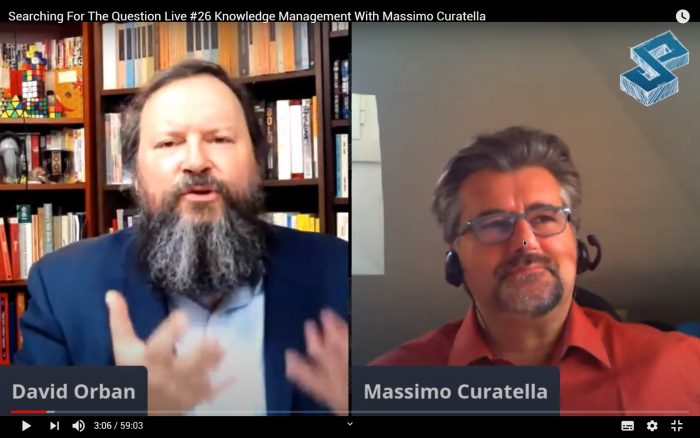
    This is an extract of the interview transcript that David Orban conducted live on the 14 April 2020 for his Internet who Searching For The Question Live. Massimo Curatella (me!) was interviewed on Personal Knowledge Management, writing and education.

    I’ve made small corrections and fixes only for the sake of clarity and brevity.

    Watch the recording on:


    Searching For The Question Live #26 Knowledge Management With Massimo Curatella


    David introduces the show, and Max

    David Orban 
    My name is David Orban and I am very glad to have all of you following the show. Before we start, I want to remind you that even if we are live you can always watch past episodes, both on Facebook and YouTube. And on YouTube, you can also subscribe to the channel. We also have a Discord community, and I invite you to join http://davidorban.com/discord. And finally, if you find the show valuable, as well as the other content that I produce and the knowledge that I share, you are welcome to become a supporter on Patreon at https://patreon.com/davidorban

    Today’s theme is knowledge management. How do you manage the information flow? What are the ways that you cope with overload? What are the best tools of knowledge management?

    The guest is Massimo Curatella. Max is a designer, a facilitator, a writer and also a friend. He lives in Rome with his wife and son and we met a few years ago when he came to a meetup I organized. I have the habit of setting up impromptu meetings around themes that interest me, such as technology-driven social change, decentralization, network society. Sometimes a dozen people come, sometimes several hundred. At the Rome meeting, there were not many people but one of them was very passionate, curious and skeptical. He held the Italian edition of my book, Something New, AIs and Us, full of notes and markups. On the first page, he jotted “Sono tutte stronzate?” “Is this all bullshit?” So we evidently had to go to have a pizza and several beers. And after the event, we kept talking into the night. Since then, Massimo became the Italian Ambassador of Network Society, a collaborator on several projects, as well as the agent provocateur on many of the things that I do. For example, He was the person behind the idea that gave rise to The Context, my weekly video series alongside this one Searching For The Question Live. One of Max’s passions is knowledge management. So I thought I would invite him to the show.

    Welcome, Max.

    Massimo Curatella
    Hello everybody. It’s a pleasure being here. Thank you for having me.

    How to manage many interests

    David Orban
    Let’s start talking a little bit about you. One of the things that is common to many people as a matter of fact, somebody just last week asked me for an opinion, because he is a designer and was redoing his website and he didn’t know how to talk about himself and the many things that he is interested in. You have the same problem. And I do too, except that I don’t care about it.

    • Is it the problem of somebody having many interests, a polyhedric personality and having some difficulty in conveniently representing him or herself to others so that he can be put in a box?

    Massimo Curatella
    This is actually a painful experience I’ve been experiencing since forever in my life, and sometimes it becomes so painful that I cannot sustain it. And so I invite my friends and I ask them to listen to me. And what I found useful is to get out of the mess that you have in your brain in terms of passions, interests, and things that you like and you love and let your friends try to recognize some patterns. To make sense together, to me is the most valuable thing.

    And something that I really appreciate for instance, in what you do, David, is that as you were saying, “I don’t care” in a way that is a provocation and a way of living and this has been always a problem with my culture, because I always been taught to be all set up perfectly, and you need to do things in the “proper way”, not specifying what’s the proper way.

    This is a limitation. To fight this limitation, it took me several years. And this is when I decided that to build my online identity or my professional identity, I didn’t care anymore about being perfect or having specific titles. So I invented some ways to manage this. I started to collect labels. And I said if I want to be interesting in a certain context, and I have a label that is relevant, I will use that label. If I don’t want to talk with people, I will say the opposite. And it worked. So this is one of the ways to manage multiple facets of your identities.

    David Orban
    We are all full people, right? We are not mono-dimensional or bi-dimensional we are multidimensional and as in the beautiful book Flatland by Abbot, talking about how a cube meets the inhabitants of a bi-dimensional world and how it is difficult for them to communicate because the cube is not suffering from their limitations. Similarly, I believe it shouldn’t be your fault that you have so many interests if you are efficient in pursuing those interests and anybody should be able to see you in a given projection. And then if you develop a deeper and broader relationship with them, that projection will encompass more and more of what you are. To establish a professional relationship that is based on just a given section and a given perception of what you are is perfectly appropriate.

    Knowing wide and knowing deep

    Massimo Curatella
    Yes, this is true, I agree, but it’s a matter of your culture and your attitude to life. I feel that in most of our contexts, especially in the Italian culture when we talk about school and how you develop as a human being, this is not promoted. This is not facilitated because you are supposed to find your place as soon as possible, you need to settle down and you need to find your title and you’re going to be your professional title. And this has been a curse to me. This is one extreme but, at the same time, the opposite of being completely open, but superficial on many different topics like a butterfly, without ever focusing on something and going by deep diving. Do you know the metaphor of T-shaped people? (By the way, I am an O-shaped person) It’s when you can go wide and broad on topics but if you are polled on a specific concept you are able to go deep down and be able to have profound conversations about it. This is, for instance, what I really appreciate when we meet because we can talk about anything: life, universe, or c++.

    The need for a culture of experimentation and innovation

    David Orban
    What you said about Italian culture is sad because the necessity of telling a very young person that they are whatever happens to them in that moment for the rest of their lives was a necessity 100 years ago, but it is a profound condemnation today. And it really forces an entire population, not to experiment not to enjoy the alternatives possible, not to evolve with the needs and necessities of society as it is improved by technology.

    • So what do you do with your own children or child?
    • How can you tolerate this kind of violence that they go under at school?

    Creating an environment conducive to creativity 

    Massimo Curatella
    This is a serious issue, and I live it every day. What I do is to try to nurture an environment that is conducive to be eclectic, and with many interests. And I try to always invite my child to anything that I do for work and recreation. And sometimes I use him as a sparring partner, as a creative person. I did that yesterday for a workshop I had to organize with 100 people. And I tested a prototype with him and I told him: “work with me for one hour, I want to see how it works”. The difference is in how you treat the person. Because if you treat a young human being like a child that needs to be fed and you have to wait for them to become persons, one day… This is what our parents were doing with us and I don’t want that. So I talk to him. When I want, as a child, as my son, but most of the time as a person, I talk with him about going to Mars or what Elon Musk is doing with reusable rockets or The Context by David Oban talking about living on the moon. And he is so excited and sometimes, it’s like planting seeds, you cannot see the immediate fruits of that. But after years or weeks, you get some returns because it comes back with the drawings, with ideas with worlds he wants to build on Minecraft. And this is fantastic, but you have to be present in everything that happens. You need to change your attitude. So educators or parents or relatives are absolutely important in the environment of young minds.

    Coronavirus as a boring horror movie

    David Orban
    How is life in Rome these days with the lock-down and everything?

    Massimo Curatella
    It’s surreal. You would see scenes that are really familiar to any other place around the world. And the first time that I had to get out to buy groceries, it seemed to me like I was living in a movie scene from 12 monkeys. I felt like Bruce Willis, navigating this incredibly deserted world. And I was scared, you see people in long queues and they are way farther than two meters one from the other. And you can feel the embarrassment, the fear in the eyes of people.

    On one side you still see the elders being absolutely not disciplined (along with the younger). One of the best scenes I was part of was a person with plastic gloves, and a mask, he went into a bakery and he bought a piece of pizza bianca. He put down the mask and he started to eat in the middle of the road like, nothing was happening. I said, so why are you wearing a mask?

    On the other side, this was a month ago, the first time that I met my mother in law the instinct was to hug ourselves. And I said, Okay, no, no, we need to touch our feet. This is what they used to do in China. So this is our way of saying hello. And it was fun and sad at the same time.

    Sped-up digital transformation

    David Orban
    A lot of people who postponed the adoption of modern tools are now forced to use video conferencing and share the collaborative platforms, documents, either on Google or Microsoft Teams or maybe some open source solution as well. And they are hopefully going to realize that there is nothing to fear that it is going to be good to keep going with these tools even when the peak of the pandemic has passed and when children go back to school and, and when the workers are back in their offices. 

    So what do you think about the relationship between the tools of knowledge management and the ability to manage knowledge?

    Becoming intentional in digital knowledge managment

    Massimo Curatella
    This is the essential concept that we need to address for people like me who like to play with everything and experiment with everything and they keep on having thousands of ideas, everything they do. Having infinite space at the finger for free. It’s a curse. It’s like the tool you’re using right now Facebook or Instagram or Twitter, with a finger you keep on scrolling, scrolling, scrolling, it’s just like drugs. You’re addicted, you go there and you scroll for hours. Now the same is happening when you can save any piece of information. With the illusion that one day you will read it or with the illusion of knowledge since you have grabbed a beautiful piece of writing or an article or a video. You have the illusion, the dopamine boost, of being smarter. And this is, unfortunately, so easy that I frequently fall into that. And this is what I’m trying to fight by trying to be more intentional. This is the most important thing we need to nurture in our children and in ourselves, to be intentional. We should still be open to serendipity, finding things where you’re not looking for it. But that cannot be 90% of our lives. At the same time, trying to be more intentional needs discipline. So I’m doing a lot of effort in trying to ask myself, why am I saving this link? I’ve been collecting information since 1995 and I still have those collections. I still have them after 25 years, with the illusion that one day, maybe I will review them because I remember there was something interesting. And it’s like prehistory, it’s the archaeology of myself. After 20 years, I really don’t care. The difference today is not what I’m saving, but what I’m gonna do with that information.

    David Orban
    And I like letting go of things that once I thought were so important, I feel it as a cathartic moment when I realized that it had its place and now it has a different place and I can do without and I also like Saving, stuffing the knowledge that I am not going to, for example, read the article that I am saving, but I have an expectation of an increasing utility in the tools that surround me. So that they will be able to derive the correlations among the components of the information that I am saving in order to surface in a contextual manner, what is relevant in a given time in the future and, and there are glimpses of that already. For example, even though it is a tool that we used to love and now we love it less because we believe it may not last forever and we are a little bit afraid of its proprietary nature and format. Evernote when you start writing, it’s pretty good. Bringing you other notes saying this might be relevant to what you are writing. And also, there are other tools that are doing similar things.

    • Do you believe that it is reasonable to expect AIs to become effective assistance? And pretend that whatever we don’t do is because we don’t want to make the effort, they will do it in our place.

    Think strategy before technology 

    Massimo Curatella
    I hope so. But of course, we have to discuss what we mean by that. I’ve been dreaming about Google before it was born. I was dreaming about Yahoo groups before it became a reality. And my idea was to have my brain in a digital format so that I could share it with anybody else on the internet. I could create a connection while I was sleeping. At the same time having the assistance of Google or Alexa is, for now, a little bit more than a toy. But when you mention tools like Evernote or Notion or others,  they are powerful, advanced, but still, if you are not disciplined, they are going to become a mess very soon. So we’re not there yet. I want Google to tell me, 30 years ago, you were thinking about this. Do you want to have some more information about this concept? Because there is David talking about this right now. This is what I want.

    The future of Personal Knowledge Management will be in our brain

    David Orban
    Or given your browser history, I know that whatever you attempted 30 years ago, you were not ready. But now you are ready because you have acquired the skills and what you wrote, contains certain components.

    We have Sabina Spagna, saying that children must be stimulated in every context. And this is called divergent thought. And it is also a successful movie and a book hasn’t read it but I know it’s very popular.

    Neuralink is one of the newest Elon Musk companies, where he’s able to rapidly assemble an excellent team, where he gives instructions coming from his approach of first principles, redesign of solutions to achieve a tenfold or a hundredfold improvement on anything that was possible before. Neuralink wants to achieve the ability to interface our brain and our thoughts directly with computers. And with other humans at a depth and speed and completeness that would make us all for every practical purpose telepathic. But we have a problem with bandwidth. If we communicate like this, the effective transmission of information via a spoken word, it is not a very high rate, especially if I am not a good communicator. So, Neuralink wants to increase the communication bandwidth between humans and our exo-cortex.

    The only people who want to go through the effort of doing that are the paralyzed. Today the first attempts with Neuralink will be on people who have no alternative. But yes, there will be a time when the system will be less expensive, less cumbersome, less dangerous, less delicate, and it will not require FDA approval and exception anymore. And that is when many of us will eagerly embrace that.

    Flip education 

    David Orban
    Time is money and getting relevant knowledge needs precious time.

    • How can we make sure that the information we get is relevant and that both children and teachers can use the best methods available? So what do you say, Massimo, to that?

    Massimo Curatella
    Do exactly the opposite, ask children to teach to teachers, this is the very first thing you should do.

    David Orban
    And what is needed in order for that to happen?

    Massimo Curatella
    We need a transition in our culture and in the system because, of course, if you are living on the salary that you are getting by giving tests and giving rating you cannot do otherwise than that. So the system needs to be changed. In fact, I think the teachers right now are victims of the system. They are not only the perpetrators of what they’re doing. So I feel compassion and I’m empathetic to them. Because when I was a teacher, I had the luxury of doing whatever I wanted. So in any class that I was teaching, I said, you don’t want to do that? You do want to do computer graphics. You want to do photography, let’s do photography! And the student, you know, didn’t pass the course. But he was so happy. And he changed his life. He did another job and after 15 years, he’s saying thank you, Max!

    Systems Change starts with you

    David Orban
    Now, what about the family pressure where they need to study in order to pass a given admission to the next school and then the next school and then the next school for 20 years, at least or you know, if somebody stops at high school after 12 years or 13 years, whatever it is there? because we are talking about children and teachers and the families right, all three have to agree that the current system is not working

    Massimo Curatella
    When we talk about changing the system, the system has different levels, the first level is yourself, then you have to go in circles, and expand them gradually and see who you have near you. You have your family, this is still the system, and then you get outside, then you have the school, and then you have the nation-state, the government and then the world. So you cannot act only top-down or bottom-up, you have to intervene in all of those levels. That’s why it’s so difficult. That’s why I keep on failing every day.

    Knowledge Management in the workplace

    David Orban
    Since the title of this episode is knowledge management, it is not surprising that we are talking about schools and children. But the same challenges are applied also in the workplace where a very hierarchical and centralized decision system pretends to assign you tasks that you do unquestioningly and then measures the time that you spend on the task and the more time you spend, the more important the task is. And if you questioned the method, you are seen as rebellious and dangerous and set aside. Now I’m describing the worst possible workplace, but is the challenge harder or easier in your opinion to re-calibrate the minds and the culture around what we really need to focus on what matters in terms of how to cope with the information flow and what is happening?

    Massimo Curatella
    It depends on the environment where you’re working. And workplace and personal knowledge management, they are two different things. But of course, there are similar kinds of approaches and methods. In the workplace, If you are in the old school, I don’t think you have any chance you have to follow the hierarchy. I was having some pains in working in a very strict hierarchical system where I wanted to share knowledge and share information with my colleagues higher or lower. It was a problem. It was a problem because I was not respecting the hierarchy. Now, in a very formal, scientific environment I can even think there could be some benefits, of course, because otherwise, it is completely chaotic. But I still feel that it’s a sort of limitation because it’s very old school, you get beaten on your hands, why did you do that? you have to pass by me! And even if you go a little bit lower in medium-sized organizations, even in Italy, they are still like this.

    Knowledge Curation and Personal Knowledge Management

    Massimo Curatella
    When instead you go and work with people that are more open and modern in terms of sharing and managing knowledge, what I really appreciate is where everything is transparent and available to everybody. In that case, you have other kinds of problems, because you have too much. The next step is to curate knowledge, Personal Knowledge Mastery becomes the needed approach. What do I want to do with the knowledge I’ve acquired? In the workplace, if we are working together, we need to have conversations and work actually together to discover what we need and aggregate and let the information grow. So that one day we will have clusters of something that is meaningful or relevant to us.

    David Orban
    I really don’t like when somebody just shares a URL, and nothing else. And when they do it on their own wall, and maybe they asked me to be a direct connection, what Facebook calls a friend, I look at their walls, and it’s just a series of links with zero context, zero opinion, zero curation, as you say, and I just can’t accept, because I don’t need that human to be a collector of links. What I want that human to be is a thinking value adding actor that provides his or her opinion on whatever is important.  

    I want to make sure that our viewers can find you. So they can go to curatella.com Is that like a cold cut from Rome? That’s how it sounds to me. Maybe too close to dinner. That is why I think mortadella-Curatella

    Massimo Curatella
    That’s the worst joke they used to do to me when I was a young boy, but it’s not. It’s actually a plant and it is coming from South America. I think it’s Curatella Americana. It’s herbal medicine. And it is a nice name because it reminds “curating”.

    David Orban
    All right. So, on your website curatella.com there is contact information and people can get in touch with you. To have you design and facilitate and write and do all the other wonderful things including provoking and upsetting and disrupting.  Which you do very well as well. So, as we go towards the end of our hour together, what would you like the people who are here, take away? What can they do to make our conversation actionable to them?

    Building a writing habit

    Massimo Curatella
    Oh, that’s a beautiful question. I am a technologist. I am a software developer. I do software engineering, I love technology. What I will tell you is: forget about technology, widgets, smartphones, unless you can use those toys to really augment your brain, the first thing that I would suggest is to write, you have to write, you have to get things out of your brain. Writing is painful if you’re not accustomed to it. To reach the stage of publishing on my blog, I’ve been writing a quarter of a million words, privately, nowhere to be found, only for me. And it was an immense effort.

    David Orban
    And you posted it somewhere, and I commented, well, where are those words? Yes. Why are you hiding them?

    Source: https://www.facebook.com/massimo.curatella/posts/10156649105881910

    Massimo Curatella
    Yes, what I suggest is to try to work on your character by building a habit. It’s even more painful than quitting smoking or sugar. But once you’ve discovered the power of having an outlet getting thoughts out of your brain, it’s a superpower, you cannot do without it, you will change, you will change your life. So, write, you will think better, publish, and then think about technology.

    David Orban
    So, the people who should be recommending technology as the solution, you specifically recommend a deeper analysis and understanding of the objectives and of the outcomes, and only when that is better understood to find the tools but at the end tools do make us better and faster in achieving what we want to do, or even sometimes to do what seemed impossible when we couldn’t read or write. The ability to aggregate and curate knowledge was severely limited by oral culture. The invention of writing was fundamental. When we invented airplanes, we really started to do something that all humans dreamed about and almost all of them believed it would never happen and it would be impossible. So I understand and agree that analyzing in the abstract or within yourself, what are your goals, How do you really want to understand the task or the knowledge that you are managing is important, but I also think that the tools and technologies can help us over achieve With respect to what we would be doing without them.

    Technology can help to build your digital brain

    Massimo Curatella
    I agree completely I could not live without technology. And that’s why I have several thousands of digital books. I have an enormous amount of notes in several collections. And there are tools that will help you if you have your intention to collect a certain kind of knowledge. For instance, you mentioned Evernote, I would like to give you some suggestions about some tools: one is RandomNote for Evernote that would pick for you randomly every day a note from the past. So it would reemerge, you will get inspiration about something you have said in the past. Another suggestion is the Zettelkasten where this concept is taken to an extreme. This guy, Niklas Luhmann, in the ’60s created a slip-box method where every concept would be written on a card as a note, identified by a numerical ID, and every note would be connected to others through a relationship. So, basically, by following numbers, he would have been able to create a dialogue with his notes, with his brain. And that was on paper. Okay, today I would never do that although maybe on my back you can see something that wanted to reproduce that. Today, I would do that with Evernote, or with Notion and Readwise or with WordPress. I would export all the notes that I’m getting on my Kindle. and using a tool that is called readwise.io, I would get all these interesting pieces of knowledge to come back up to me, maybe in six months, maybe in three months. So technology can absolutely help. If you go on my website curatella.com/notes, that is my experiment with my second brain online. To write something publicly, you need to be confident. Am I writing something that makes sense? And then you need to connect it. That’s why I have keywords, pointing at key concepts that I want to use in the articles that I’m writing. It is a lot of work, but that’s the way to do it.

    Conclusion

    David Orban
    Wonderful. So Massimo, thank you very much for being a guest on the show.

    Here on Searching For The Question live. That is what I do every day, experiment with new tools, and invite guests to take part in these conversations. And you can also vote for who would like to be one of our next guests on the URL that you see on the screen. And you can come and participate in the discord community to have conversations that we can have beyond the live stream as well. And the opportunity is absolutely open for us to keep these conversations. 

  • Networking by communicating your challenge

    Networking by communicating your challenge

    Focusing on a specific mission is hard. If you’re not clear about it it’s even harder to communicate it. This is how it went with my presentation to Ozan Varol’s Inner Circle.

    Connecting with Smart Strangers

    I was invited by Ozan Varol to an online meeting to share my challenges with his Inner Circle Community.

    I use to commit myself to slightly embarrassing challenges to push me to get prepared. One of my tricks to learn, better and faster. Another one is to teach what you want to learn. The call was about asking for help with one of your challenges, members from the Inner Circle community would come to brainstorm solutions and give you help.

    While the poor Ozan was asking for a simple and straightforward question to ask my kind voluntary good-doers, I started to think about the meaning of life and why the Universe exists.

    Don’t you believe me?

    This was my original draft: “challenges-to-discuss”.

    If we are all on this ride together: Is it worth caring about questions that are not the most important ones?

    How can I live a more intentional life?

    How can I be financially sustainable while creating something which will outlive me and be remembered as a positive contribution to the progress of society and improvement of life on the Planet?

    How can I reach as many people as possible and increase the quality of their lives through education?

    How to dance with uncertainty?

    How to become an intervener in my reality?

    How to provide value and to whom?

    How can I engage, being useful, without being boring?

    How can I use the opportunity of raising children to improve my worldview, my beliefs, and my values?

    Not bad as “informal” and “quick” questions to submit to never met before people, kindly dedicating from 15 to 30 minutes of their time to listen to you…

    With infinite diplomacy skills, Ozan made me notice that I would have needed one, two paragraphs, maximum, to introduce my challenge to be discussed.

    Pushed to reduce my philosophical worldview to something more manageable I tried to focus on what are the most urgent themes dear to me. And I got this shortened list:

    How can I keep the habit of Writing every day.? I Wrote for 140 days, about 200’000 words

    How can I Publish every week?

    Walking at least 1’000 km per year. How can I sustain my habit?

    How can I Make a living as an independent publisher and professional?

    Obviously (dear me), this was not short enough. So while meeting with a client, replying to emails and chatting with friends (it was a calm day) I really felt inappropriate to reach meeting time with so ambitious challenges to share.

    With a lot of effort and a bit of pain, I’ve tried to focus on the single most important step I wanted to validate among the many in my grand vision.

    And finally, it started to make sense.

    This is what I finally submitted:

    Consider that  I want to become financially independent by publishing, primarily on my blog at https://curatella.com and to grow as a professional who is contributing to raising the collective intelligence through design, education, and facilitation.

    If you visit my home page and you read in particular the sentence:

    “Hi, I am Max. Here you can learn more about design, writing, facilitation, and teaching.”

    Which are linked words, would you hire me as a facilitator?

    What can I do to improve my presentation?

    But it was too late!

    Meeting time arrived and I had to introduce myself, my blog and my challenge by speaking, I scratched almost anything I’ve prepared and I’ve asked the group:

    If you read my article at:

    Facilitation is the set of structured and collaborative activities organized to discover, understand and learn together. The facilitator helps a group of people and decision-makers to face complex problems, producing a collective intelligence more powerful than each individual could do, alone.
    1. Would you think it is too pushy and sales-y?
    2. Would you hire me as a facilitator?

    The feedback gathered

    The great patience of the participants allowed me to get precious feedback which was:

    1. I have too many doubts about publishing. I should just write and publish without too much thinking.
    2. Even if I reduced my fields of interest to the four appearing in the Home page, I should either reduce them down to a more focussed one or find a more digestible and clear way to communicate the common thread binding them all.
    3. I should write article drafts and leave them unpublished for some days. Then, with fresh eyes, I should edit those drafts pretending they have been written by somebody else.
    4. I should enjoy more of the process of writing and publishing for the pure sake of it.
    5. Only by publishing a lot of content, I will be able to find my voice and fine-tune my content strategy while understanding better how to relate to my audience.

    I really enjoyed this improvised and unprepared collaboration. I got inspiration and motivation to write more and better and I’ve also found a more focussed challenge to face in my writing path: to be more spontaneous and to find a way to present an eclectic and multi-perspective content strategy.

    Thanks to: Ozan Varol, Christina, Cathy Cheng and all the other participants of the Inner Circle.

    Well, now is your turn: what is your question for me about my writing at https://curatella.com?

  • What to write about

    What to write about

    What should you write about? How can you find the inspiration for a new article or a new diary post? What is capturing your attention and is worth of further thought? What does deserve to be put in words for somebody else to be read?

    If you know already why you should write, read along to go on a journey to find what to write about.

    What keeps you awake at night?

    The negative things. Your financial sustainability. Your health concerns. Your anxieties, your worries. Your greatest fears. Your regrets, your remorse, your sorrows, your pains.

    The positive things. Your wildest dreams, your ambitions, your aspirations and your inspirations. How to become an artist, a writer, a painter, a filmmaker. How to grow a child, a partner, a relationship.

    Write about what keeps you awake at night.

    How to save the world

    Does the world need to be saved? Be more specific: what can you do to improve even one little component of that huge system called “the world”? How can you be a better human being having a positive impact on society and the environment? Are you rich? How can you do effective philanthropy? What’s the best way to use money, wealth, and abundant resources to improve the lives of as many living beings as possible?

    Write about it.

    You’re not rich? How can you have a positive impact on the world and the ecosystem without having infinite resources? Or, just a little? Or, nothing?

    That’s even better: write about it.

    Write about how you are going to save the world.

    Checking your knowledge: what do you know?

    Writing clarifies thought. And the clarification passes through the assessment of your knowledge. Try this exercise: what do you know? Pick a topic, the one you cherish the most, your passion, your professional field. What is, actually, that you know about it? Would you be able to open a blank document and to, without reference, write everything about it in a clear and systematic way? What are the foundations? The key concepts? Principles and values? Tools and techniques? Methods, tricks, attitudes, behaviors, traps?

    Write about it. Write about what you know. And then, check what your wrote against the most authoritative sources you can find: how much of it is comparable? What did you get right? And wrong? What did you miss?

    Write about it. Write about what you discovered by doing an improvised and unprepared writing session about a topic.

    Understanding and Learning: what don’t you know?

    What is that you need or you want to understand? What skills do you need to acquire to perform better in your job, in your athletic discipline, in your spiritual endeavours? How do you know that you know?

    And, maybe, the most important question is: how can you discover those things that you don’t know you are ignoring?

    Write about it.

    Write about the things you don’t know and you want to learn about.

    Create your Knowledge Matrix

    Keep track of the topics falling in the category of “The Things You Want To Write About”. The list will be embarrassingly small, at the beginning. And by curating it, it will become amazingly long.

    You need the equivalent of the Anti-Library proposed by Umberto Eco: the books you still have to read. You need a Knowledge Matrix, a systematic and structured list of topics you want to write about crossed with canonical questions.

    What are the writing prompts to start researching and writing about a topic?

    Begin with the most famous and immediate ones:

    1. Why
    2. What
    3. How
    4. When
    5. Where
    6. Who

    Just as a starter. But, be aware. Researching a topic by intersecting the knowledge about it with philosophical questions doesn’t necessarily lead you to a well-written essay. That’s another story. But in order to write you need first inspiration and raw material to build up your exposition. The Knowledge Matrix is a starting point, a creative tool to put you in the position of having always something to write about. Moreover, following the Canonical Questions you can aim at being exhaustive and critical.

    Write for your future self.

    What is that bothers your about your life? What do you want to change about it? What knowledge and intellectual resources do you think you’ll need more? What is the inspiration that you are missing? What catches your attention because of an unexplained intuition?

    Write about it.

    Write for your future self. Don’t think too much, write organized units of knowledge to be addressed at your future self. You are, at least, two persons, and they can be very different: your current being and your future version of you. Take the person in the future as somebody else and, with loving care and dedication, write to them as the dearest friend you can have. What do you want them to know?

    Write about what your future self needs to know.

    Write for your “past”

    What is that you would have wanted to know when you were younger? What is that you wanted to know when you were 8? Or 80? What did you want to know last year?

    Write about it. Pick a real person, that you love or care about, that you know and at least can relate to. They should be younger than you. They could be much younger than you: think about children, for instance. What is that you know and is in your experience that you want to pass to them as your legacy?

    Write about it. Write about what you would have wanted to know at the age which, currently, is somebody who you care about.

    Write, unconsciously

    If you make an effort to develop a habit of writing daily, you could equip yourself with one of the most powerful skills a creative could have: free-flowing creation.

    When you stop being aware of your surroundings and focus only on your fingers tapping. On the words, slowly, appearing on your screen. And when you start to finally listen to your inner voice, but not the symbolic one: the voice of your mind. The real “you”, talking in your head. When you are in the creative flow, in a focused, undistracted, intense session of writing, non-stop. When you are “in the flow”, you have established a direct connection with your brain.

    You can recognize this heavenly state when you see words appearing on the screen which almost surprise you. When you reach the capability of writing almost as fast as the speed of your inner voice talking, then you are “in the flow”. Nothing can interrupt you. There is no pressure, no guilt, no fear. And words just appear out of nothing.

    That moment, there, is when you can be purely creative. Listen to that voice, the most inner expression of your being. Listen with dedication and love. Just let it flow without interruption. Your goal is not to say meaningful things or to explain what you are writing.

    Just write. Write your mind. Write your thoughts.

    Only after rest, reflection and editing you will be able to dive into the sea of your written thoughts to fish for precious pearls. Only after having collected, cleaned-up and curated your thoughts as precious gems you will be able to create intellectual jewels out of them.

    Write about it. What have you discovered while you were in the free-flowing creative mode?

    You don’t know what to write about? Read

    Read. Whatever is in your reach and in your interests. Read books about known or unknown topics. Read newsletter, blogs, online articles. Read newspapers. Read whatever could bring you new concepts and inspiration with the voice of somebody else.

    But, here is the point, write about what you read. You should not just keep your eyes entertained by serifs and sans-serifs. By glyphs of beautiful fonts printed on the most precious paper. You have to engage the author with critical questions. And you have to stop, at the end of each meaningful section, and rewrite the concepts in your own words.

    Write about what you read. Do not be a passive reader ingurgitating millions of words about which, for the majority, you will forget about. Stop, question and reflect about what you read. Summarize it and enrich it with your knowledge, make connections with related concepts. And write about it.

    Be always capturing inspiration

    Keeps a notebook near your bed and write down any thought or dream as soon as it happens. It will become the source of your writings. If you write fiction it can be the inspiration for a story or a character. Otherwise it can be a hint about your unconscious mind and you can study it to learn more about the intimate you.

    Write about any inspiration you come up with and keep it safe and organized.

    Curate your archive of writings

    Create a central archive of anything that you write. Enrich each document with a proper title, a description and maybe some tags to categorize it. Capture the essence of the context around it: when did you write? Where were you? Take the occasion to probe your mood, your feelings and your thoughts about it. How did you feel? What was the emotional context in which you wrote that? It will become a multi-purpose archive of your life: a diary, a sketchbook, an emotional journal, a performance tracker.

    Create your list of writing prompts

    You should have your list of writing prompts, extend mine, add your personal ones, make experiments and refine it.

    Did you find my list of creative source of inspiration useful? Will you use it? Are you already using some of those prompts? What writing prompts would you add?

  • How I write

    How I write

    Between the 24th of September 2019 and the 31 of December 2019, I will have written for 100 days straight. I wrote every day for an average of 1’200 words per day. I’ve produced over 120’000 words. I collected more than 130 articles in my dedicated folder: some days I wrote multiple times. That amount, if printed, would fill about 500 pages at the standard average of 250 words per page.

    How much of this is good?

    All of it and I am going to tell you why.

    Writing is thinking

    I can think better when I write. I collect thoughts which, in great part, I would have lost because I would have forgotten them. I can dedicate focused attention to an idea, an inspiration or a problem. I can grow an archive of thoughts that I can search, compare and browse. I can be more precise with memories because they’re written down, I don’t have to make any effort, I just have to look for that thought.

    Writing is a habit

    The hardest part is to be fluent, constant and coherent. It’s important to go over the threshold of being able to type quickly without looking at the keyboard. Or, most importantly, to not type at all. I’ve been typing on a keyboard for four decades: I am fast, I can type blindly. This is an enormous advantage. You can cultivate this skill: this is strongly recommended.

    Or, just don’t type at all. Technology is marvelous magic: you can talk to your computer, it will type your words for you. Or, even better, get out for a walk, a long walk and talk to your phone. Either it will transcribe it or you can record a file, better for archiving and nostalgic purposes. You will upload it as soon as it’s ready. A few minutes later your transcriptions are readily digitized in your email or your cloud folder.

    Yes, it’s not a perfect technology, yet. But having from 80 to 90% accuracy while recording on the street, in the city, is pure magic.

    Moreover, editing your draft brings some benefits: you listen actively to your thoughts trying to catch the right words, misspellings, and concepts. You put a certain distance between the “you” who was speaking at the recorder and the present “you” in the role of the editor. Another benefit: you become aware of the useless interjections as the “ahm”, “uh”, “you know”, etc. I was able to almost eliminate any unwanted occurrence of such bad speaking habits. An added benefit: I have improved my speaking skills.

    Facilitate starting

    Preparation rituals. Create a checklist that you will refine indefinitely.

    Prepare the environment. Put your most inspiring music or noise generator. Use earphones or earplugs. Go in the quietest place of the building. Or, if you record, get out on your most loved path.

    Avoid distractions. Turn off all notifications from any device: desktop and laptop computers: email, instant messaging, web conference, social media; tablets, smartphones, landlines, buzzers, whatever is not vital, turn it off.

    If you need to remain available choose only one single medium of communication with your important ones and establish a code. Make yourself unavailable for the time needed to write.

    Set a threshold: time or quantity. I started, for fun, the “500 words per day” challenge. Some people do the “250”, others the “750 per day” or the “3 pages per day”. It’s not important. What matters is setting a daily goal. You should make it much more affordable and reachable if you are just starting. If you feel insecure try with something ridiculously easy as “10 words per day”. Can you write 10 words per day? Think about it: this is a sentence with just a little more than 10 words: 19, to be exact. Can you write a sentence per day?

    Ignore the “what”. What should I write about? It is not relevant. You just need to write. It’s like playing scales when you exercise with the piano. It’s a psychological exercise, not a creative endeavor. Let the words flow from your brain. Creativity will come. Naturally. When you will forget what you have to write: then the magic will happen.

    Go with the flow. Go in the flow

    Get focused on your writing only. Allow yourself time to get warmed. Feel the connection with reality fading away. Forget you are moving your fingers to type. Become one between eyes, arms, hands, fingers, keyboard, screen, text flowing.

    Reach the speed at which you are listening to your thoughts, free-flowing and just… transcribe them. It doesn’t matter what you are thinking: just write it.

    You will discover it will be easy to tell your truth in this state. You will listen to your inner voice saying unexpected things which, usually, you recognize as indubitable truths that, maybe, you were not able to express any other way.

    Keep the pace: write every day

    Don’t skip a day. If it happens don’t skip it twice and don’t catch-up with the lost one. Your first goal is not to write but to be able to be consistent with your commitment against all odds.

    I cheated. Yes. I did. I confess. I felt so painful the lack of motivation to write and I did not do it for two days, at the very beginning of my challenge. After two weeks I could not stand to see those two lines empty. In a frenzy, I started to search for everything I could consider passable as “writing” to fill those hurtful holes. Nothing! I had nothing! I’ve been recording dozens of hours of notes, I wrote thousands of emails, I sent an infinite number of… yes! Chat messages. So I put together the threads I’ve been following those days and I was able to cover my daily goal. Is this useful? I don’t know, not really in terms of having kept the commitment. But surely I feel like I don’t have to look at empty log lines. It was an important lesson for the following days. I would have not skipped another day for anything in the world!

    Anticipate, foresee unexpected events. Of course, life happens. And it doesn’t matter how much you plan: unforeseen things are real. That’s another harsh lesson I learned. It doesn’t matter how much relaxed and safe your day might look like. Block time early before normal “life” hours, usually before 8 a.m., much earlier if you can afford it and: write!. Even on the most tranquil day put your goal in the safe. You’ll always have time to go beyond your threshold.

    Block dedicated time on your calendar: set a reminder, do not postpone it. Set an appointment with yourself. Yes, this is what I do. It’s set at 7 a.m. It’s the first notification I get in the morning (together with any other coming from other timezones) and I get an email reminder. That specific warning, piercing through my retina as a bloody red dot in the tray bar is there pushing in painful part of my skull saying: “you have to write!”. And I don’t allow myself to postpone it. It stays on, and as an unread email until I’ve finished my writing ritual.

    The pleasure released when I am finished and I can delete that reminder is one of the most cherished pleasures of my current life.

    Don’t choose a topic: curate your thoughts.

    As I wrote in Why Should You Write? you are the best person in the world to make excuses for yourself. If you want to find a reason not to write, trust me, you will. And asking the most natural and logical question: what should I write about? It is the killer’s excuse. The mother of all excuses. Pregnant with beautiful children as “what if I don’t have anything to say?”, “What if I don’t know what I am talking about?”, “What if I don’t feel prepared without accurate research?” There you go. That is the way to declare defeat before even starting.

    This “free-flowing writing challenge” is for you to unblock you. To stretch your fingers (and your mind), to create stamina, to be able to prepare yourself for a long-term commitment. The goal is to write. Where did I write you should have to “write 500 words per day about a popular topic in the news?” Or about a “professional field”? Or about a story of how two people traveled to the other side of the world to find themselves?”

    You don’t need to check. Nowhere. The challenge here is to improve your ability to establish a more intimate connection with your inner voice. With your thoughts. And, tell me: do you ever think? Because what I am talking about here is writing as in “transcribing your thoughts”. That is what I am talking about. So, you have no excuses. You just need to recognize that voice always talking in your head. That is you. And, please, listen to it. What is it saying? What are you saying, in your head? That is the matter, the source, the input? And there is no judgment involved, whatsoever. We don’t care about correct spelling, punctuation or style. You don’t give a damn about it. Just focus on the words. Pick them one-by-one and transcribe them. Either with your keyboard or with your voice. What is it all about? You don’t care.

    At least for now. Follow me and you will discover what to do about it.

    After you have passed through the painful moments of starting this journey, you will feel ashamed of the incredible stupidity expressed by your timid and unstructured thoughts. After some days, that depends on how much you can hold the pain, things will start to make sense. You’ll be faster to catch your thoughts. They will start to have more sense when put one after the other. You will start to recognize patterns of meaning. Recurring thoughts. Elaborations on previous concepts.

    That’s the moment! Is there, that I want to bring you. That moment when you will start to lose perception of your fingers touching the keyboard. Your fingers will dance, on their own, at the sound of the most beautiful music. The sound of your brain talking. You’ll start to listen to the flow of ideas. They will start to compose more coherently. You will want to follow, listen and to interact! That is the moment when you are finally starting a dialogue, live, real-time, with your inner voice. And, my friend, at that time all about rituals, distractions, screens, fingers, all of it will become irrelevant. That is the moment when you have opened a door to your mind.

    What then? Just listen and transcribe.

    It’s only after having collected some thousands of words that you will take the time to reread, filter, select, aggregate. You will curate your thoughts. And you will discover the “what” you have to write about. Because you already did it. You have now just to keep going.

    Track your progress: do or do not, there is no try

    You can be obsessed with statistics about the number of words, the time spent in writing them, and the like. But the single most important data to track is: did I write today? Your only goal is to answer: yes.

    It’s as simple as that. There are no other criteria.

    Then, since you’re supposed to have digital copies of your writing, well, you can unleash the most advanced Artificial Intelligences and Data Visualization techniques to extract as much statistical data as you can. It can be useful but remember, you are building a habit. Writing something meaningful or useful for any other application is going to be just a consequence of the consistency of your practice.

    How am I going?

    I started, bored, unhopeful and a little desperate. I’ve been trying to write consistently for 20 years. I’ve started 100 times and failed 100% of it. So I was expecting the usual gig: some initial exciting little pieces and then, as usual, everything would fade and fail miserably.

    ✍🏻 Updated on the 31st of December 2019

    Yes, I’ve made it! 🥳

    And, instead, joyful joys have me, I not only did the 31 days as required by the “challenge”, but I’ve also reached 100 days and I have no intention to stop soon.

    Benefits, So far

    I created my personal knowledge matrix. This is how I want to call it, a table of topics where the columns are the canonical questions which will drive my inquiry. Can you guess them? They are: why, how, what, when, where, who. While the rows are the topics emerging during my exploratory writings: I am not a single-passion man, sorry, so they range from Design to Computer Graphics, from Futurism to Software Development, from Personal Knowledge Management to Systems Thinking. And (un)fortunately for me this is just a very small sample of what emerged.

    I’ve published my first blog! I’ve been planning to do it for too many years. Now I did it and what you are reading is the second article, the first one was Why Should I Write?

    I’ve built a new habit. It doesn’t matter how my day is going to be composed: I will reserve from 15 to 60 minutes to write. I feel immensely satisfied with this. It gives me confidence and hope. At the same time, I realize it is just the start. Writing is not enough: I want to publish, as well.

    My writing and speaking skills have improved. I can feel the improvement in my writing skills, both in English and Italian, my native language. I perceive a concrete improvement in the effectiveness of my communication skills. My style improved as well. Since I’ve recorded dozens of hours in English, I can see how my oral exposition is more coherent, understandable, and tidy, compared to when I started.

    I’ve walked for 300 Km in three months. I used to do it for one year, walking for 1’000 Km, so I maintained this habit and I merged it with the writing one. I’ve recorded lots of hours of notes while walking which I’ve then transcribed with digital tools. The immensely satisfying consequences are, not only saving time but losing weight and gaining a lot of health benefits derived from this practice. Joining walking and voice recording is one of the best things that could have happened to me.

    Conclusion: just write!

    So, how much are 100 days of writing worth? So far they are the world to me. They meant an incredibly exciting challenge with me, with my life, my job, my family and all the odds against me. I proved to myself that I can change my habits, in positive. I can pursue a more ambitious goal of nurturing my intellectual progress. That I can sustain the pain and the patience to exercise to improve a skill so crucial for me that, I am sure, will be responsible for future opportunities I am not even able to imagine.

    This is how I write.

    And you? How do you write?

    Which of the tricks, tools, and techniques I’ve mentioned are you using? How can I improve with my approach? What should I start doing? What should I stop?

  • Why should you write?

    Why should you write?

    There are many reasons for you to write. Some of them are rational, useful and motivating. Others are irrational, detrimental and generated by your biased way of thinking. The success of your efforts lies in the one you will choose. Why do you want to write?

    For vanity

    Because you are ambitious and you aim at writing timeless and precious things which will make you famous, admired and immortal.

    To change the world

    Our behaviors are influenced by our thinking. To think in a more efficiently and effectively way you need to adopt a Systems Thinking and a critical thinking approach. It will allow you to better evaluate how to address the global challenges of the 21st Century. You are part of the Human Network and you need to contribute to increasing the quality of thinking of individuals and organizations: from small companies to nation-states.

    For self-therapy and self-awareness

    To keep track of your life so you can read back what you were doing, what you felt and what you were talking about at different times. You can reflect and get insights into your recorded thoughts and behaviors. You need to become more self-aware.

    To improve your writing

    Any skill improves with practice and short rounds of feedback loops. Write to improve your writing skills, especially if you are not a native speaker of the language you are writing in.

    To improve your thinking

    Writing brings clarity. Knowing you are publishing your writing requires you to have a certain level of confidence in what you write. Motivate yourself to improve your writing by publishing it.

    To strengthen your personal brand

    As a freelancer professional writing and publishing about the topics in your industries would help in making you perceived more interesting and trusted. It will lead to professional opportunities: get ready to welcome them.

    To learn more and better

    You need to drive a wider and deeper learning of the world and yourself. You should find a balance between the serendipitous wandering of knowledge and the exploration of specific topics you are interested in.

    To meet new people and to interact with them

    Learning adventures can make you feel on a solitary path, too much unbalanced on the input, reading and digesting side without much interaction. Expand your network, look for more interactive exchanges with whom might provide an alternative, critical point of view compared to yours. Exposing your opinions leads self-selecting people to network and resonate with you. Find your tribe. We need many and none at the same time. You need different communities where to manifest and explore your interests. On the other hand, you need to better focus on creating those which are more fertile ground to nurture your continuously changing interests and aspirations.

    To learn new habits, for your personal development

    You can discover you are capable of changing your habits by establishing rituals, rhythms, and systems. Dampen the less useful habits and reinforce the more productive ones. Writing requires discipline, rituals, and rhythms: it’s the perfect ground to test your capability to self-develop your habits.

    What are you afraid of?

    When you publish your writing you could be afraid of:

    • Not finding an audience, not gaining traction.
    • Saying stupid things.
    • Being stupid.
    • Being ridiculed.
    • Not being up to the task.
    • Not being able to maintain a publishing schedule.
    • Writing in an incorrect language.
    • Leaving tracks of things which could be used against you, one day.
    • Not knowing what to write.
    • Losing interest in doing it.
    • Not having a clear focus.
    • Being unable to make it sustainable.

    All of the previous is plausible, none of the above is mandatory.

    What will happen if you write?

    You can discover it only by starting right now.

    Write!

    What is your motivation to write?

    I am here, listening. Tell me: what are your motivations to write? Your desires? You can share your fears, too, if you want.

    Quotes

    The best time to start a blog was 20 years ago.
    The second best time is today.

    Massimo Curatella